


Gerard
Co-CEO and Strategy & Competitive Alignment Practice Leader
The Alta Group

Jackson
Co-CEO and M&A Practice Leader
The Alta Group

LoMonaco
Senior Managing Director & Business Assessment Practice Leader
The Alta Group

Remiker
Vice Chairman
The Alta Group

Halladay
Director
The Alta Group
In January, The Alta Group’s 2026 Insights said that 2025 ushered in an age of whiplash — a series of “start-stop” cycles during which every forward signal was paired with a cautionary message to hold tight. Six months into 2026, that whiplash has continued. The first half did not produce a straight-line recovery, but it confirmed a core premise of our outlook: equipment finance companies are finding growth in a market that remains complicated, selective and vulnerable to external shocks.
Our predictions were directionally strong on industry momentum, AI infrastructure, uneven sector performance, tariff uncertainty and credit discipline. The first half was less cooperative on timing and causality. Demand improved without the rate relief many expected. Inflation remained stubborn. The market sprinted out of the gate, then cooled. And several themes we identified — particularly M&A and clean-energy equipment financing — remain valid but need more evidence before they can be called first-half wins.
We have updated our Alta Pulsepoint tool to reflect what the first half of 2026 has confirmed, complicated or left unresolved (Figure 1). The revised view helps equipment finance leaders distinguish between themes already supported by evidence, themes that require recalibration and themes that remain important watch items for the balance of the year.
What We Got Right
1. Equipment finance entered 2026 with real momentum. Our January outlook anticipated that pent-up capital expenditure demand would begin to be unlocked as companies adjusted to operating amid persistent volatility rather than waiting for perfect clarity. That proved correct. The Equipment Leasing and Finance Association’s (ELFA) CapEx Finance Index (CFI) reported record new business volume of $11.6 billion in January. However, January’s surge did not translate into a sustained expansion as CFI volumes contracted from February through May before rising again in June. Nevertheless, first-half volume grew a solid 11.3% from the prior year, supporting our view that customers could not defer investment in mission-critical equipment indefinitely. It is worth noting that some of that demand applies to reshoring and nearshoring-related manufacturing investment, where plant construction, capacity expansion and equipment needs are beginning to turn a long-discussed theme into financeable demand.
2. AI infrastructure became the growth engine we identified. One of Alta’s strongest calls — made in both our 2026 Insights and our June 2025 Monitor article on AI infrastructure — was that AI would create financing demand well beyond software. First-half 2026 confirmed that this was not a niche theme. Demand continued to build around data centers, high-performance computing, power availability, cooling capacity, connectivity, storage and edge AI applications.
For equipment finance companies, the most accessible opportunity remains in the equipment layer rather than in the larger hyperscale data centers. That means financing cooling systems, power-management equipment, networking assets, backup systems, modular data-center assets and specialized AI hardware where platform expertise, asset knowledge and structure matter. The key is not simply to “finance AI,” but to understand which assets, refresh cycles, residual-value risks and structures — FMV leases, bundled financing, subscription models and as-a-service offerings — fit how customers are deploying AI infrastructure.
3. Growth was selective, not broad-based. We predicted that 2026 would not be a rising-tide environment. That also proved accurate. Technology and software-related investment carried more momentum than several traditional categories, while transportation, construction, manufacturing and other segments remained mixed. Recent market feedback points in the same direction: some platforms are reporting strong quarterly results and running ahead of plan, while others are seeing margin compression, tougher risk-adjusted pricing and limited visibility beyond the next 60 to 90 days.
4. Tariffs remained a defining wild card. Our forecast treated tariffs as one of the most important sources of uncertainty for borrowers, OEMs, lessors and funders. The first half confirmed that view. Tariff policy shaped capital planning, equipment cost assumptions, supply chain strategy and customer behavior. The issue was not only tariff costs but also the difficulty of planning around changing rules, litigation risk, delayed pass-through effects and customer hesitation. Late-July tariff escalations — including broad new duties on dozens of trading partners and announced 50% tariffs on a range of Canadian goods — only reinforced how quickly trade policy can reset cost assumptions, supplier strategies and timing decisions.
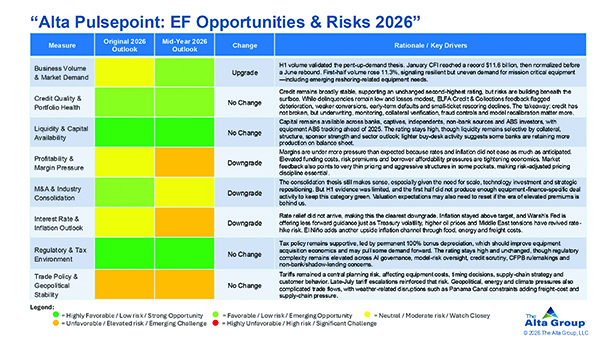
The midyear results are encouraging, but they are best viewed with cautious optimism. Alta’s 2026 outlook got the big directional calls right: resilience, selective growth, AI infrastructure investment, tariff uncertainty, supportive-but-selective capital availability and disciplined underwriting. The misses were mainly timing and intensity. Rate cuts did not arrive as expected.
5. Credit discipline remains crucial, especially in light of reduced predictability and uneven metrics. We warned that high-profile defaults and fraud events could expose hidden structural vulnerabilities and reinforce disciplined underwriting. The first half did not produce a broad-based credit event. In fact, ELFA’s June CFI showed industry-wide delinquencies at a multi-year low and losses remained modest. But industry conversations suggest headline metrics may understate emerging pressure. At ELFA’s June Credit & Collections conference, practitioners pointed to portfolio deterioration, weaker conversion rates, early-term defaults, and post-booking rescoring, which revealed steep credit-score declines in some small-ticket portfolios. The message was not panic, but caution: models are becoming less predictive and lenders are having a harder time identifying defaults before they occur.
The pressure is also uneven. Small-ticket and small-business portfolios are seeing more strain than larger-ticket and larger-company credits, while transportation and construction remain sectors to watch as insurance, fuel, tariff and broader cost pressures compound borrower stress. Some portfolios remain excellent, and certain transportation exposures appear to be working through the charge-off cycle. AI investment is becoming a credit concern because many organizations are deploying AI before its economic value and revenue models are fully proven. If adoption outpaces demonstrable returns, markets may reassess risk, increasing credit pressure for some borrowers. The implication is clear: disciplined underwriting must be paired with sharper monitoring, better early-warning indicators, fraud controls, workout readiness and a willingness to recalibrate models as borrower behavior diverges from historical patterns.
6. Liquidity and capital availability remained supportive but selective. First-half growth was supported by ample liquidity across bank funding, private credit, warehouse lines and securitization markets. Equipment ABS activity provided another proof point: broader ABS issuance is running ahead of last year’s pace, and equipment ABS is part of that momentum. Recent market feedback also suggests buy-desk activity has been lighter, as many players focus on building balance sheets and retaining more production, although that could shift later in the year if management teams seek additional fee income. The caveat is that liquidity is not indiscriminate. Funders and securitization investors are differentiating by collateral quality, structure, sponsor strength, sector outlook and credit performance.
Where Reality Was More Complicated
1. Rate cuts did not become the tailwind many expected. We believed continued Fed rate cuts could help unlock pent-up demand by lowering financing costs and improving borrower cash flow. Instead, the Fed held rates steady through midyear and again at its July 29 meeting, citing persistent inflation, solid activity and elevated uncertainty. The result is a more complicated rate backdrop than our January outlook assumed: rate relief is not arriving quickly, Kevin Warsh’s Fed is offering less forward guidance, and Treasury market volatility suggests investors are weighing not only a longer pause but also the possibility that rates could move higher again if inflation risks intensify.
Even without rate relief, equipment demand held up better than expected because customers still needed to replace aging assets, invest in technology, respond to competitive pressures and manage tariff-related timing decisions. The lesson: lower rates are beneficial, but they are not the only driver of equipment investment.
2. Inflation remained stickier than hoped while risk broadened. Inflation was identified as a risk, but the first half suggests it deserved more weight. Borrowers continued to face elevated costs for labor, equipment, materials, freight and financing, while geopolitical pressures and higher energy prices added another layer of concern. Sticky inflation, slower momentum, higher energy prices and policy uncertainty have increased the risk of stagflation-like conditions — an issue Alta examined last year in the context of the equipment finance industry. This year’s predicted Super El Niño also deserves mention as an upside inflation risk because severe weather can affect food, energy and freight-cost channels simultaneously. For lessors and funders, affordability pressure remains real even when customers have a business case for acquiring equipment. Market feedback also points to margin compression and unusually aggressive risk-adjusted pricing in some areas, with some transactions not fully compensating funders for the added risk associated with moderate or tougher credit profiles. That makes structuring more important, particularly where FMV leases, rentals, shorter terms or usage-based models can help customers manage cash flow and preserve flexibility.
3. Equipment Finance sprinted out of the gate, then normalized. January’s record CFI reading was followed by four months of declines before a June rebound, but first-half volumes still ran ahead of 2025. That points to normalization rather than deterioration, as deferred purchases, tariff-related timing decisions and mission-critical replacement needs continue to work through the market. CapEx demand and backlogs remain healthy, although limited visibility beyond the next 60 to 90 days is creating greater nervousness around fourth-quarter activity.
4. M&A remains plausible, but not yet proven. We expected modestly higher M&A activity in 2026, particularly among strategic buyers, private-capital-backed platforms and regional banks seeking scale. That thesis still makes sense as firms look to spread technology investment across a larger asset base and reposition for selective growth. A more favorable dealmaking and regulatory environment could support continued bank M&A, although first-half evidence is not strong enough to call M&A a clear win. Conditions for deal activity are improving, while uncertainty around rates, inflation, geopolitical conflicts, tariffs and credit continues to affect timing. Investors continue to favor experienced lift-out teams as a faster path to market entry and a way to avoid the higher acquisition premiums associated with existing platforms. The next phase of consolidation may depend less on peak valuations and more on realistic pricing, strategic fit, funding certainty and the ability to underwrite earnings through a more volatile cycle.
5. Clean energy is still an opportunity, but the strongest first-half proof point was power demand tied to AI. We identified clean-energy equipment, storage, grid modernization, efficiency technologies and related infrastructure as opportunities. That remains true. But the first-half story was less about a broad clean-energy acceleration and more about power demand tied to AI infrastructure, data centers, electrification and grid strain. The industry opportunity is real, but it is clearest where concrete demand drivers — battery storage, backup power, cooling, grid resilience and energy efficiency — support financing demand.
6. Policy support improved on tax, but regulatory complexity did not disappear. Permanent 100% bonus depreciation, enacted as part of the One Big Beautiful Bill Act, should improve the economics of qualifying equipment placed in service after 2025 for those not constrained by NOLs or 163(j) interest expense limitations. It may become a more important demand catalyst in the second half as customers factor the benefit into capital-planning decisions. At the same time, the broader regulatory environment remains mixed. AI governance, model-risk oversight, credit-underwriting scrutiny, Consumer Financial Protection Bureau (CFPB) reconsideration rulemakings and concerns about non-bank or shadow-lending activity keep this from becoming an unequivocally favorable category.
What to Watch in the Second Half
The second half of 2026 will test whether early-year momentum can persist in a higher-for-longer — and potentially more volatile — rate environment, making these Alta Pulsepoint watch items especially important. We are watching seven indicators closely: whether CFI new business volume remains above its 2025 pace; whether delinquencies, early-term defaults and small-ticket stress stay contained; whether Fed policy under Kevin Warsh becomes more or less predictable as markets weigh renewed rate-hike risk; how quickly tariff effects, including late-July escalations, flow into equipment prices and borrower behavior; whether AI infrastructure investment continues to broaden beyond the largest hyperscalers; whether equipment ABS and other funding channels remain open but selective; and whether tax incentives translate into incremental equipment demand.
For management teams, the implication is straightforward: this is a market for selective offense. The companies best positioned for the balance of the year will stay close to customers, protect credit discipline, price for uncertainty and build flexibility into structures. They will keep funding relationships active, monitor securitization market appetite and stress-test exposure to energy-, freight-, tariff-and weather-related cost shocks. They will not assume every sector is recovering at the same pace, nor wait for a perfect macro signal before supporting customers with clear operating needs.
The midyear results are encouraging, but they are best viewed with cautious optimism. Alta’s 2026 outlook got the big directional calls right: resilience, selective growth, AI infrastructure investment, tariff uncertainty, supportive-but-selective capital availability and disciplined underwriting. The misses were mainly timing and intensity. Rate cuts did not arrive as expected; the policy path became less predictable; inflation remained stubborn; margin pressure increased; and demand cooled after an unusually strong start. That is exactly why this remains an age of whiplash. The firms that thrive will move with confidence while recalibrating quickly as conditions change. •
Valerie L. Gerard is co-CEO and Strategy & Competitive Alignment practice leader, Jim Jackson is co-CEO and M&A practice leader, Rick Remiker is vice chairman, Shawn Halladay is director and Gary LoMonaco is senior managing director and business assessment practice leader — all at The Alta Group.