
This year’s Monitor’s Bank 50 companies reported $272,594.1 million in 2021 net assets, a 0.6% decline from the $274,298.7 million reported in 2020. But when it came to originations, the group bounced back from the 13.9% decline reported in 2020 to book $93,677.3 million in 2021 new business volume, a 6% year-over-year increase.
The top four banks retained their respective positions in the asset ranking, while Huntington Asset Finance catapulted from No. 12 to No. 5 after acquiring TCF Capital Solutions. Bank of America retained the No. 1 position with more than $56 billion in net assets, down 1.6% from 2020. Wells Fargo held its own at No. 2 with a portfolio of nearly $32.3 billion, down 9.3% on a year-over-year basis. PNC grew its book by 9%, exceeding $17.9 billion in 2021, and CIT held steady with more than $16 billion in net assets, an 0.9% increase from 2020.
When it came to originations, the top five experienced a slight shake up, Bank of America retained the No. 1. rank with nearly $15.3 billion in net assets, down 4.3% from 2020. Wells Fargo Equipment finance increased its new business volume by 18.1%, reporting nearly $11.5 billion in 2021 originations. Huntington slid into the No. 3 position with nearly $5.9 billion in originations, down 4.6% from 2020, resulting in PNC dropping to No. 4 in the ranking with $5.6 billion in new business volume. Key Equipment Finance held on to its No. 5 position with more than $5.4 billion in originations, up 23.3% year over year.
U.S. Bank Overview
According the Q2/22 FDIC Quarterly Banking Profile, net income of FDIC insured institutions declined $6 billion (8.5%) year over year to $64.4 billion in Q2/22 but increased $4.6 billion (7.8%) on a quarterly basis. The year-over-year reduction in quarterly net income impacted more than half of banks (51.8%), according to the FDIC.
The FDIC noted that the net interest margin (NIM) in Q2/22 increased 26 basis points on a quarterly basis and 29 basis points year over year to 2.8%, marking the largest annual increase in quarterly NIM recorded since 2010. The average yield on earning assets rose 36 basis points from Q1/22, which the FDIC attributed to “strong loan growth and rising market interest rates.” However, cost of funding stayed below pre-COVID-19-pandemic averages.
The balances of loans and leases increased by $913.6 billion on an annual basis, according to the FDIC, driven by consumer and family real estate activity. Commercial and industrial loans grew $151.8 billion (6.5%), but growth was tempered due to Paycheck Protection Program (PPP) loan forgiveness and repayment. The FDIC noted that annual C&I growth would have been 22.4% if PPP loans had been excluded.
Top Bank 50 – Rankings (article continues after images)

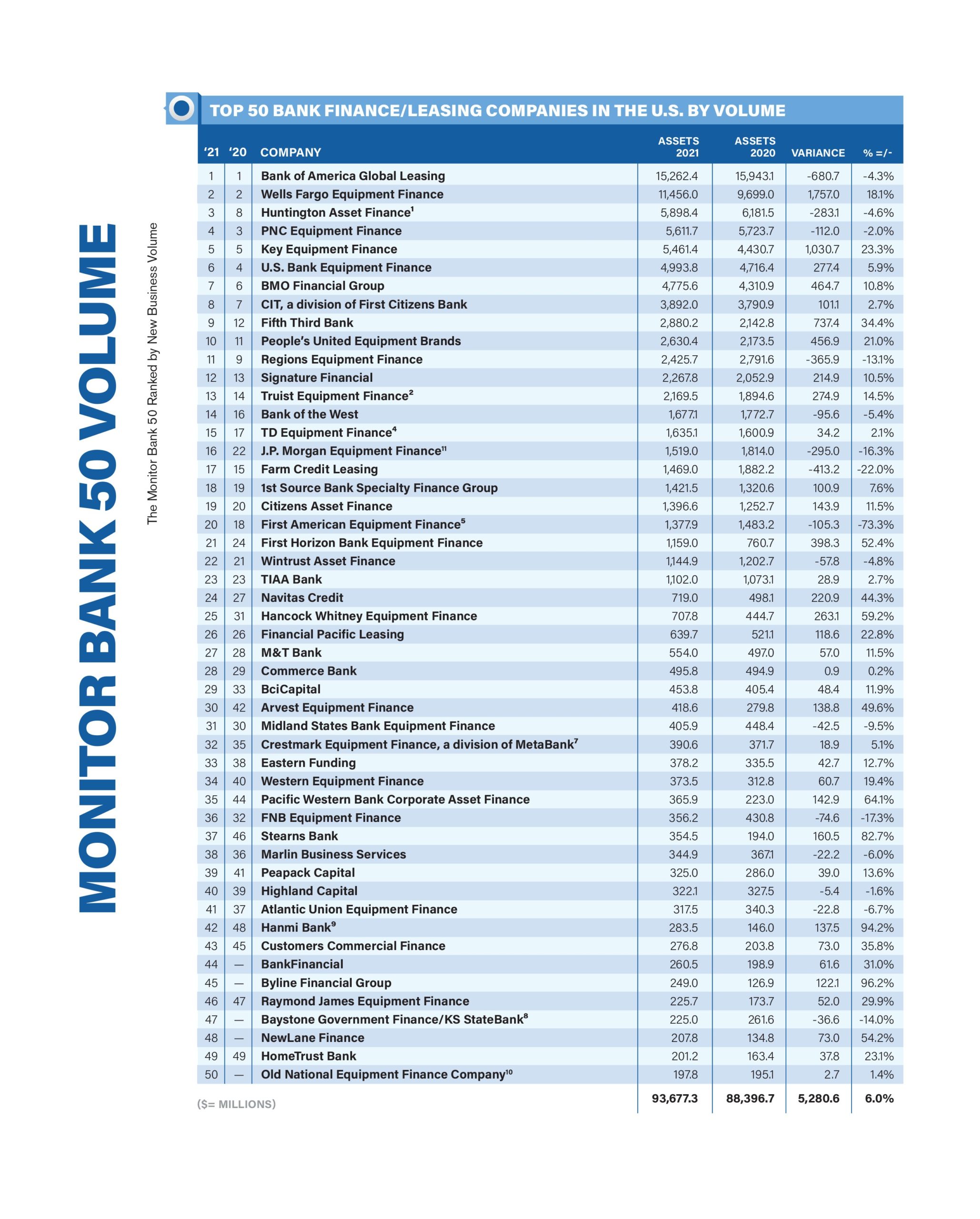
Monitor’s Bank 50 companies reported nearly $272.6 billion in 2021 net assets, down $1.7 billion (0.6%) year over year from nearly $272.3 billion in 2020. Of the group, 31 banks reported combined portfolio increases totaling nearly $7.3 billion, while 19 banks posted combined portfolio declines of nearly $8.7 billion. Huntington posted the largest year-over-year dollar gain of the group, increasing its net assets by nearly $1.6 billion in 2021. No. 43-ranked Atlantic Union Equipment Finance achieved the highest annual percentage gain of the group (70.5%), growing its portfolio to $560.1 million from $328.6 million in 2020.
In the volume ranking, the Bank 50 companies reported combined 2021 originations of nearly $93.7 billion, up 6% from nearly $88.4 billion in 2020. The majority of banks (35) combined to post increases in new business volume totaling nearly $7.9 billion, while 15 banks reported combined declines of $2.6 billion. Wells Fargo recorded the highest dollar increase in new business volume, growing its 2021 originations by nearly $1.8 billion to reach nearly $11.5 billion for the year. The highest percentage gainer in new business volume was No. 45-ranked Byline Financial Group, which added $122.1 million (96.2%) to its 2020 originations effort to achieve $249 million in 2021 new business volume and its debut on the Bank 50 list.
Arrivals & Departures
Five new companies joined the ranking this year, including Baystone Government Finance, ranked No. 39 with $692.8 million in net assets and $225 million in origination. Old National Equipment Finance Company, ranked No. 46 and formerly known as First Midwest Equipment Finance, joined the group with a portfolio of $468.3 million and $197.8 million in volume. Making its debut at No. 47 was BankFinancial, with $402.6 million in net assets and $260.5 million in originations. Coming in at No. 49 was Byline Financial Group with a portfolio of $357.8 million and new business volume of $249 million. And finally, NewLane Finance made it debut at No. 50 with $345.8 million in net assets and $207.8 million in originations.
Forecasts
Of the 49 banks that provided an asset forecast for 2022, 37 anticipated an increase in portfolio size, while two predicted a decrease and 10 planned to hold steady. Calculated on an average weighted basis, the group forecast portfolio growth of 3.6%, which would result in collective net assets totaling $283.7 billion for the group in 2022. Looking back at last year, the banks predicted 3.2% growth in their portfolios but missed the mark by roughly 3%.
When it came to volume, the 40 banks that provided a forecast planned to expand originations in 2022. When calculated on an average weighted basis, the group predicted a collective increase in new business volume of 4.6% in 2022. Last year’s group predicted that the Bank 50 would increase volume by 12.8% in 2021, more than double the 6% the group managed to achieve.
The banks appeared optimistic when it came planning staffing expansions in 2022, with 35 planning to hire new employees, three planning to keep their teams the same size and three predicting a decrease in staff. Overall, the group planned to increase staffing numbers by 4.9% by year-end 2022.
Monitor thanks all the participants and their staff members who provide us with the survey data we rely upon to produce this report. As always, we welcome your feedback and commentary.
Rita E. Garwood is editor in chief of Monitor.