
The 2024 asset class rankings highlight steady leaders, surprising growth stories, and sharp declines that are reshaping portfolios across the equipment finance sector.
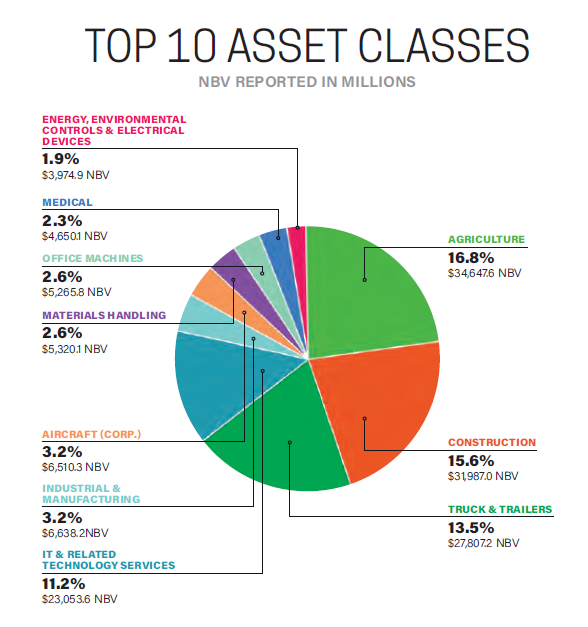
The equipment finance industry reflected both resilience and volatility, as some asset classes posted strong growth while others struggled. Trucks & Trailers saw mixed performance, with Bank of America Global Leasing and BMO Financial Group maintaining their positions as leaders, even as Wells Fargo experienced steep declines. Caterpillar Financial’s overwhelming market share dominated the construction sector, although challengers like DLL posted notable growth. IT & Related Technology Services consolidated at the top, with Dell Financial Services leading the way, while smaller players, such as DLL, gained momentum. Industrial and materials handling sectors faced broader pressures, with several leaders losing ground as competitors seized opportunities to expand. In the medical sector, growth was clear, with DLL USA and Dext Capital recording substantial increases. These dynamics highlight how portfolios are shifting, pointing to continued strength in technology and healthcare and ongoing challenges for more traditional categories heading into 2025.
 TRUCKS & TRAILERS
The Trucks & Trailers market in 2024 showed both stability and disruption. Bank of America Global Leasing led with $4.24 billion in new business volume (NBV), securing a 24.3% market share and posting modest growth. BMO Financial Group followed at $3.31 billion, nearly 10% higher than its 2023 figure. MassMutual Asset Finance, managed by Barings, delivered the fastest growth rate among the top five at 30%, highlighting its rapid rise. Wells Fargo Equipment Finance, however, posted a sharp 38% decline, dropping from $3.6 billion to $2.26 billion. PNC Equipment Finance rounded out the top five with $1.54 billion and stable performance. The results underscore how aggressive new entrants are challenging traditional leaders.
CONSTRUCTION
In construction, Caterpillar Financial Services continued its dominance with nearly $11.9 billion in NBV, capturing almost 90% of tracked market share and growing 9% year-over-year. John Deere Financial followed with $4.1 billion, up 6.4% from 2023. Wells Fargo Equipment Finance posted $2.75 billion but fell 6.9% compared to the prior year, while CNH Capital and DLL USA completed the top five. DLL stood out with a 30% surge, underscoring how challengers are starting to carve out a niche in a Caterpillar-led sector.
IT & RELATED TECHNOLOGY SERVICES
Technology continued to be a cornerstone of equipment finance in 2024. Dell Financial Services led with $8.37 billion in NBV, controlling over one-third of the market despite a slight year-over-year decline. Cisco Systems Capital ranked second at $3 billion, posting modest growth of 1.4%. Bank of America Global Leasing dropped more than 30%, while Wells Fargo slipped slightly. DLL USA, although smaller with $815 million in revenue, gained traction with an 18.5% increase, the strongest growth rate among the top five. The sector continues to consolidate around leaders, yet players like DLL are climbing quickly.
INDUSTRIAL & MANUFACTURING
The industrial and manufacturing segment reflected overall weakness. M&T Equipment Finance Group topped the list with $632.7 million in NBV despite a 7.1% decline. Bank of America Global Leasing, once a strong player, saw its revenue decline by 42% to $463.9 million. First American Equipment Finance and U.S. Bank followed, with U.S. Bank posting an 8.6% gain. BMO Financial Group rounded out the top five with flat performance. The general downward trend highlights tightening conditions, with only a handful of players maintaining or expanding share.
MATERIALS HANDLING
In materials handling, Wells Fargo Equipment Finance led with $1.13 billion in NBV but declined 12.2% from 2023. Bank of America Global Leasing followed with $785.7 million, also a decline of nearly 5%. DLL USA ranked third with $584.4 million, achieving a 8.3% growth. U.S. Bank and First Citizens Bank closed the top five, with First Citizens emerging as a bright spot thanks to 23% growth. The sector showed diverging trends: leading firms are scaling back, while smaller competitors are steadily expanding.
MEDICAL
The medical sector has been highlighted as one of the most consistent growth stories of 2024. DLL USA led with $996 million in NBV, up 8% year-over-year. Bank of America Global Leasing posted $534.1 million, up 3.8%. U.S. Bank Equipment Finance followed with $453.4 million, gaining momentum with a 16.3% increase. Dext Capital, though smaller at $298.3 million, expanded by more than 11% and claimed a leading market share in its niche. First American Equipment Finance was the only top five player to decline, down 10.3%. The results indicate steady growth among established players and rapid expansion by specialized entrants.
SECTOR PERFORMANCE
The broader equipment finance landscape in 2024 reflected clear divides. ELFA’s What’s Hot/What’s Not survey ranked construction, machine tools, medical, high-tech, and marine as the most attractive categories, driven by fleet replacement, healthcare expansion, and demand for digital technologies. By contrast, telecom, trucks and trailers, furniture/fixtures, and printing landed at the bottom of portfolio preferences. Cost pressures and oversupply weighed on the transportation sector, while digitization continued to erode demand for printing. Despite uneven sector performance, overall NBV continued to grow modestly. ELFA data showed that the December 2024 NBV increased by 8% month-over-month, consistent with a year-end surge. Monitor 100 companies collectively posted 2.5% growth for the year, demonstrating the industry’s resilience.
FORECAST FOR 2025
Looking ahead, early indicators suggest technology and medical sectors will remain engines of growth. The Equipment Leasing & Finance Foundation’s Q3 2025 Economic Outlook noted that investment was “heavily concentrated in technology and medical” at the start of the year, with potential support from interest-rate cuts in the second half. At the same time, policy changes pose risks: accelerated phase-outs of clean-energy tax incentives could weaken investment in energy and electrical equipment, while tariff uncertainty may prompt demand to shift forward and create uneven order flows. Taken together, the outlook for 2025 suggests a bifurcated market. Technology and healthcare are poised to advance, while policy-sensitive and traditional categories continue to face headwinds. For lenders and lessors, aligning strategies with these shifts will be critical to sustaining growth in the year ahead. •
Rita E. Garwood is editor in chief of Monitor.