
Although net assets and new business volume dipped slightly in 2024 for Monitor’s Bank 50, as a group, the companies paint a more optimistic outlook for staffing, originations and portfolio expansion in 2025.
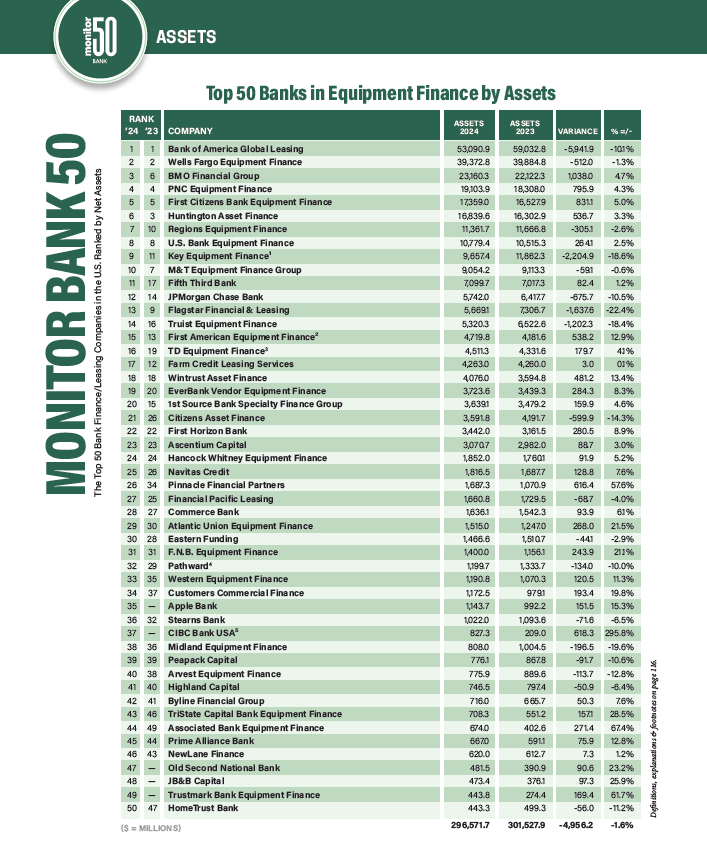
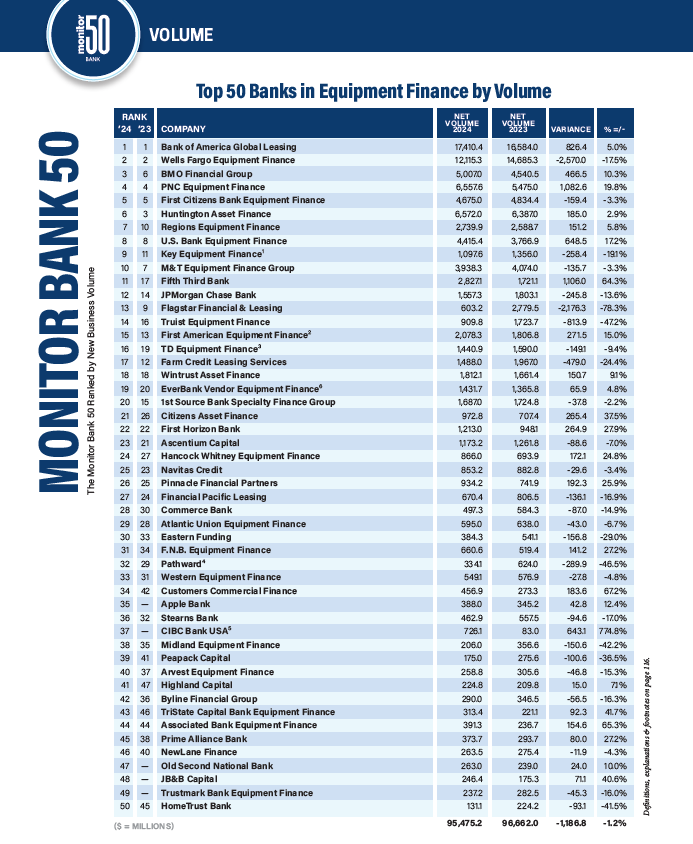
Monitor’s 2025 Bank 50 reported a collective $296.6 billion in year-end 2024 net assets, down slightly (-1.9%) from $301.5 billion the year before, and nearly $95.5 billion in 2024 new business volume, also slightly below $96.7 billion reported in 2023.
THE TOP 5
Established giants continued to dominate the top five. Bank of America Global Leasing continues to lead the pack at No. 1 despite a 10% year-over-year drop in assets. Wells Fargo Equipment Finance holds steady at No. 2, with a minor year-over-year decline of 1.3%. The biggest mover in the top tier is BMO Financial Group, which climbed from No. 6 to No. 3, boosted by 4.7% asset growth — an increase of more than $1 billion. PNC Equipment Finance and First Citizens Bank Equipment Finance round out the top five, both maintaining their ranks and showing healthy growth of 4.3% and 5%, respectively.
NOTEWORTHY PERFORMANCES
Several companies posted impressive gains. CIBC Bank USA stood out with a staggering 296% increase in assets, growing from $209 million to $827 million and jumping into the rankings at No. 37. Associated Bank Equipment Finance grew 67%, moving from No. 49 to No. 44. Other strong performers include Trustmark Bank Equipment Finance (up 61.7%), Pinnacle Financial Partners (up 57.6%) and TriState Capital Bank Equipment Finance (up 28.5%).
TOP 5 — NEW BUSINESS VOLUME
In the volume ranking, Bank of America Global Leasing holds firm at No. 1, growing its new business volume (NBV) from $16.6 billion to $17.4 billion — a 5% increase. Wells Fargo Equipment Finance remains No. 2 but posted a significant 17.5% drop in NBV, from $14.7 billion to $12.1 billion. BMO Financial Group rose from No. 6 to No. 3, thanks to a 10% gain that pushed its volume above $5 billion. PNC Equipment Finance maintains the No. 4 spot, but with a solid 19.8% year-over-year increase, it’s the fastest-growing among the top five. First Citizens Bank Equipment Finance rounds out the top tier, despite a slight dip of 3.3% in volume.
STANDOUT NBV PERFORMERS
The most explosive growth came from CIBC Bank USA, which rocketed its NBV by nearly 775%, from $83 million to $726 million. Customers Commercial Finance also posted a 67% increase, climbing into the top 35 with $457 million in volume. Associated Bank Equipment Finance and TriState Capital Bank Equipment Finance gained 65.3% and 41.7%, respectively, and Fifth Third Bank surged 64%, lifting its volume past $2.8 billion and jumping from No. 17 to No. 11.
U.S. BANK OVERVIEW
FDIC-insured banks posted $69.9 billion in net income during Q2/25, according to the FDIC’s Quarterly Banking Profile. Their return on assets was 1.13%, according to the FDIC, while the net interest margin dipped by one basis point from the prior quarter. Overall asset quality held steady, and the number of institutions on the problematic bank list fell from 63 to 59.
In Q2/25, commercial lending activity at FDIC-insured institutions showed renewed momentum, even as the broader banking industry contended with challenges tied to asset quality and provision expenses. Total loan balances grew by $263.7 billion — up 2.1% from the previous quarter — driven in part by increased demand in key commercial segments. Notably, lending to non-depository financial institutions (NDFIs) and margin loans accounted for the largest portion of this growth, although classification changes also played a role.
Asset quality trends point to ongoing stress in certain commercial loan segments. While the overall rate of past-due and nonaccrual loans declined to 1.50%, still below pre-pandemic norms, some commercial portfolios continue to show signs of elevated risk. In particular, non-owner-occupied commercial real estate (CRE) loans remain a concern.
In response to credit risks, the banking sector modestly increased its reserves. Industry wide, the reserve coverage ratio rose to 179.4%, which indicates a buffer against potential commercial loan losses. Still, community banks saw a slight decline in coverage as their noncurrent loan balances grew faster than loss reserves. These trends highlight a commercial lending environment that is growing yet still navigating pockets of stress — especially in areas tied to CRE.
STAFFING
The 2025 Bank 50 companies reported mixed, but ultimately optimistic, outlooks on bank staffing trends. Among 50 banks surveyed about their year-over-year staffing changes from 2023 to 2024, responses were almost evenly split: 22 reported increases, 24 reported decreases, and only three indicated no change.
FORECASTS
However, the forecast for 2025 tells a different story — one of broad confidence and planned growth. Of the 42 banks that responded to the staffing forecast, 34 plan to increase headcount. Only three expect to reduce staff and five anticipate no change. This sharp contrast with the prior year indicates a significant shift in sentiment. Whether driven by improved market conditions, digital transformation, or expansion plans, most banks appear poised to invest in their workforce.
The takeaway is clear: despite recent contractions, banks are ramping up staffing. The intent to grow headcount signals renewed confidence in the industry’s trajectory and possibly an expected uptick in demand for services, technology or operational capacity.
The 2025 portfolio forecast from the Bank 50 reflects a strong, forward-looking stance on net asset growth and lending activity: 32 expect their portfolios to grow, 14 anticipate no significant change, and only four project a decrease. This signals broad-based confidence in market conditions and borrower demand. However, the banks’ expected rate of increase remains cautious. Based on a weighted average, the reporting banks expected a collective portfolio growth of 1.6%.
The 2025 originations forecast from the Bank 50 shows strong momentum across the lending landscape: 35 expect to increase originations, 11 anticipate no change and four project a decrease. Calculated on an average weighted basis, the Bank 50 anticipates a healthy 4% growth in new business volume by year-end 2025. Overall, the outlook points to an active lending environment.
Monitor thanks all participants and their staff members for providing the survey data we rely on to produce this report. As always, we welcome your feedback and commentary.
Rita E. Garwood is Editor in Chief of Monitor.