


While “Liberation Day” tariffs and geopolitical headwinds have slowed the rapid growth of recent years, the Top Private Independents are shifting from a defensive to an offensive posture, prioritizing technological efficiency and internal restructuring to capture the next market wave.
Monitor’s Top Private Independents faced a year of transition in 2025. The group collectively reported a 7.6% year-over-year increase in new business volume, a notable deceleration from the 22.4% growth seen in 2024. This performance landed a far cry from the 19.5% year-over-year increase forecast by the group for 2025. However, it should be noted that the 2025 volume forecast data was collected in January 2025, before the announcement of “Liberation Day” tariffs, which rocked the industry and sparked a sharp decline in industry confidence.
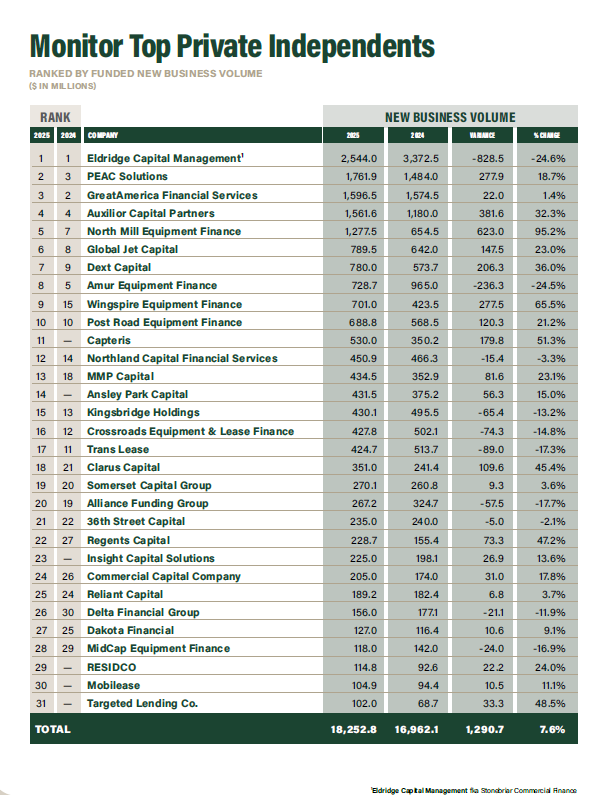
Total originations for the top private independents reached $18,252.8 million in 2025, up $1,290.7 million (7.6%). While the double-digit surges of the post-pandemic era have leveled off, the independents continue to show resilience, adding more than $1.2 billion in new volume across the year.
The Top Five
The composition of the top five shifted significantly this year, with a new entrant breaking into the elite tier and a change in name for the perennial leader. Collectively, the top five firms contributed $8,741.45 million in originations, representing 47.9% of the total volume of all ranking participants.
- Eldridge Capital Management: Retaining the No. 1 spot, the firm formerly known as Stonebriar Commercial Finance reported $2,544 million in originations. This represented a 24.6% decrease from its 2024 volume of $3,372.5 million.
- PEAC Solutions: Moving up to the No. 2 position, PEAC reported $1,761.9 million in volume, a healthy 18.7% increase over the previous year.
- GreatAmerica Financial Services: Coming in at No. 3, GreatAmerica posted $1,596.5 million in originations, maintaining consistent performance with a 1.4% year-over-year increase.
- Auxilior Capital Partners: Auxilior held its No. 4 position with $1,561.6 million in volume, a robust 32.3% gain.
- North Mill Equipment Finance (NMEF): The biggest story in the top tier, NMEF vaulted from No. 7 to No. 5 after a series of acquisitions nearly doubled its volume to $1,277.5 million, a staggering 95.2% increase.
Top Percentage and Dollar Gainers
While the overall group growth was 7.6%, individual standout performances drove the ranking’s momentum.
North Mill Equipment Finance led both growth categories, securing the title of Top Percentage Gainer (95.2%) and Top Dollar Gainer, adding $623 million in new business volume.
Several other firms posted breakout years, led by Wingspire Equipment Finance, which surged by 65.5% with a $277.5 million increase. Capteris and Targeted Lending Co. also demonstrated aggressive gains, rising 51.3% and 48.5%, respectively. Meanwhile, Regents Capital ($73.3 million increase) and Clarus Capital ($109.6 million increase) both maintained a hot streak with growth north of 45%. Closing out the high-performers, Dext Capital jumped 36% to hit the $780 million mark, while Auxilior Capital Partners proved its heavyweight status, securing a massive $381.6 million in new business volume.
New Arrivals
The 2026 ranking welcomes several new firms to the Top 30, reflecting the ongoing expansion and entry of specialized players into the private independent space. These newcomers represent a significant portion of the mid-to-lower tier of the list, with several showing aggressive growth trajectories.
- Capteris: Making a powerful debut at No. 11, Capteris reported $530 million in originations for 2025.
- Ansley Park Capital: Joining the ranking at No. 14, the firm reported $431.5 million in new business volume, a 15% increase over its 2024 performance.
- Insight Capital Solutions: Landing at No. 23, Insight Capital Solutions contributed $225 million to the group total, growing its volume by 13.6%. Before syndication, Insight reported $597 million in new business volume.
- RESIDCO: Entering the list at No. 29, RESIDCO reported $114.8 million in originations, marking a 24% increase from the previous year.
- Mobilease: Securing the No. 30 spot, Mobilease reported $104.9 million in volume. Despite its entry into the ranking, the firm noted operational hurdles in its retrospectives, including the management of parallel processes during software system transitions and a restructuring of its sales team to focus on new growth.
- Targeted Lending Co.: Targeted Lending Co. posted $102 million in volume.
2025 Retrospective: Uncertainty Breeds a Challenging Climate
While the top private independents managed to maintain growth, the qualitative feedback from executives painted a picture of a year spent navigating significant external headwinds. The primary theme for 2025 was “uncertainty” — specifically regarding geopolitical shifts, the interest-rate environment and the looming specter of trade-policy changes.
The Tariff Effect
Perhaps the most consistent concern voiced by independents was the impact of potential trade barriers. As one executive noted, “With economic uncertainty surrounding the new administration along with the threat of tariffs both on inbound and outbound goods, many of the companies in our target credit markets were wary of adding debt.” This sentiment was echoed across the industry, with another leader pointing out that the mere discussion of trade changes was enough to stall the market: “Demand softened toward the end of the second quarter, with customers delaying purchases until there was more clarity. Additionally, it was unclear how tariff increases would be absorbed or passed through to customers, creating challenges for pricing and forecasting.”
A Competitive Squeeze
In addition to macroeconomic fears, the large-ticket independent space faced an increasingly crowded playing field. One respondent characterized the environment as having “too much money chasing too few deals,” leading to aggressive pricing that compressed spreads. Another highlighted the “market-wide increase in fraudulent activity” and a “challenging credit risk environment” as significant hurdles that required firms to pivot their focus toward collateral perfection rather than pure volume.
Internal Transformations
For many, the challenges were not just external. Several firms reported that 2025 was a year of “building the foundation.” This involved “managing parallel processes to verify that new software systems were working correctly” and “changing the structure of sales teams to focus on new business growth.” As one leader summarized, the year required a delicate balance between “day-to-day execution and building a stronger operational foundation” to support long-term scalability.
2026 Focus: Efficiency, Execution & the AI Frontier
Looking ahead, the top private independents are moving from a defensive posture to an offensive one, with a near-universal focus on leveraging technology to drive efficiency and reclaim control of customer relationships.
The AI Integration Phase
In 2025, AI was a buzzword; in 2026, it is a strategic mandate. Executives are looking for ways to “leverage AI in a large-ticket shop” and figure out the “balance between technology and labor.” One leader noted that their primary goal for the coming year was to “continue to become more efficient in the day-to-day operations… with better use of the technologies available to us, such as AI and other resources.” The hurdle, however, remains cultural: “Getting everyone to use AI” was cited as a key organizational challenge.
Shifting the Origination Mix
To combat the margin compression seen in 2025, several firms are planning to pivot their origination strategies in 2026. A key focus for several independents is to “increase the percentage of direct originations mix in total volume.” As one executive explained, “This is the space where we own the customer relationship, control structure and pricing.”
Scaling Through Automation
As volume is forecasted to surge by 25.8%, firms are hyper-focused on ensuring their infrastructure can handle the load without a linear increase in headcount. This includes “fully leveraging the capabilities of new servicing platforms” and “standardizing business processes company-wide to create efficiencies across all departments.” For many, the goal for 2026 is simple: “Enhance our internal efficiencies, use of automation and technical tools. We need to realize the benefits of scale to manage growth while maintaining our high level of customer service.”
Greatest Concerns for 2026
The survey identified clear headwinds that could impact the coming year. The economy and capital spending are the overwhelming primary concerns, cited by 40% of respondents.
Other significant concerns include:
- Credit Quality of Customers: 16.7%
- Competition: 13.3%
- Margin Compression: 13.3%
- Geopolitical Environment: 13.3%
2026 Forecast
Despite the caution expressed in the retrospectives, the group’s outlook for 2026 is remarkably bullish. The top private independents are forecasting a 25.8% increase in new business volume for the coming year. This represents a significant jump from the 7.6% growth achieved in 2025 and suggests that independents believe the “wait-and-see” attitude of 2025 will give way to a surge in equipment demand and capital investment.
Conclusion
The 2026 Monitor Top Private Independents report reveals a group that is mature, realistic and ready to evolve. While 2025 was a year of moderate growth and internal refinement, the ambitious 25.8% forecast for 2026 signals that these firms are prepared to leverage new technologies and direct-to-customer strategies to capture the next wave of market opportunity. •
Rita E. Garwood is editor in chief of Monitor.
Other Featured Articles