

Has the pay-per-use excitement in equipment finance cooled down without the big wave ever materializing? Not too long ago, there was a lot of positive noise around pay-per-use and the attractive value proposition, where the lessee only pays for the actual usage of the equipment. But if one peruses finance offerings today, it seems like pay-per-use remains the exception rather than the norm.
Pay-per-use, fee-per, pay-per-outcome, PPU, outcome-based financing — these are all terms describing facets of the same idea: A lessee makes variable payments based on the usage or output of equipment, rather than a predetermined fixed payment in exchange for the ownership or possession. Lease a crane and only pay for the hours it is on a job. Lease a computed tomography device (CT) and only pay a fee for each revenue-generating scan you perform on a patient. The equipment is always available to the lessee who keeps possession, but if it is idle, it does not trigger lease expenses. Does it maybe sound too good to be true? And why hasn’t it taken off if the value proposition is so attractive?
Is this a new concept? Not really. IT software and hardware providers charge flexibly based on usage and/or features added. In the office copier business, contracts often include a usage component. Common power-by-the-hour contracts in aerospace command a flat fee for guaranteed uptime and maintenance.
One could argue, on a raw level, that rental companies already offer such desired usage- based flexibility. They charge by hour or day with flexibility to extend the term if the project takes longer. However, there is a key difference to a lease. Once the usage period is over, the customer returns the equipment, and the rental company can put it on an income generating rental elsewhere. The PPU lessor does not have the same freedom.
It seems fair to state that, in general, the equipment finance industry has been slow in adapting to a truly innovative PPU business model. While there are PPU offerings and marketing claims, under the hood, it often turns out to be a model with a narrow floor fee or a combination of fixed fee and variable component, a model incorporating a catch-up periodically or at the end-of-term, a narrowly defined one-off for a single lessee or a version where the OEM takes usage risk. Some lessors come close; there are PPU offerings, which are internally operationalized as leases with the longest possible term based on the useful asset life and incorporating flexible prepayment optionality in addition to regular, but relatively low amortization payments (reflecting the long basis term), which are marketed as minimum or maintenance payments. Anyway, in many cases, the customer value proposition is still limited.
This article reviews the challenges PPU poses for traditional lessors and their established risk management frameworks. We then look at PPU from a different angle and explore where it could be more likely to succeed. To simplify, we exclude aspects of operationalization, such as the Internet of Things (IoT) or invoicing, as well as accounting and manufacturers’ perspectives, such as servitization and stick factor.
The PPU Value Proposition
Advantages for the lessee are substantial and not limited to the following:
- Zero or limited upfront investment
- Variable costs based on usage or functionality added (e.g., additional billable cloud-based services) and alignment of expenses with business success
- Less “burden” of ownership
- ESG improvements as the lessee has an incentive to be mindful of usage and output, reducing waste
PPU can be a critical differentiation factor for the lessor in an otherwise relatively saturated market:
- Opening new profit pools and providing upside earnings potential (usage and incremental services revenue)
- Becoming a solution provider rather than an exchangeable financing source
- Increasing stick-factor and wallet share
- Improving data insights through telemetry
Finally, PPU supports asset life-cycle management by helping manufacturers retain control of equipment and it can be a valuable tool in vendor finance. Manufacturers are under constant pressure to innovate. Regarding the construction and agricultural equipment industries, McKinsey states:
“Especially for contractors, new entrants, particularly from China, moved quickly to capture demand with lower-cost, simplified machines that met the “good enough” threshold for many customers. Established OEMs responded by doubling down on telematics, embedding digital platforms directly into machines, developing proprietary applications and linking data to sales and service models.”1
Teaming up with a manufacturer for an innovative PPU offering can also mean a critical market advantage for the manufacturer.
What is Slowing us Down?
Established equipment finance companies and corporate lending arms of banks have a long history (and in the latter case, a rigid regulatory framework) of assessing lending risk in a certain way. Legacy risk management and pricing models can form an organizational and mental hurdle that impedes the implementation of innovative financing concepts.
Credit Risk Modeling
In the basic one-year model, the expected loss for a credit is determined by the probability that the borrower defaults (PD), the projected loss given default
(LGD, whereas the recovery rate is 1 – LGD), and the exposure at default (EaD):
EL = PD * LGD * EaD
On a portfolio level, modeling credit risk and incorporating correlations are much more complex and blended out here.
Pricing and Risk vs. Reward
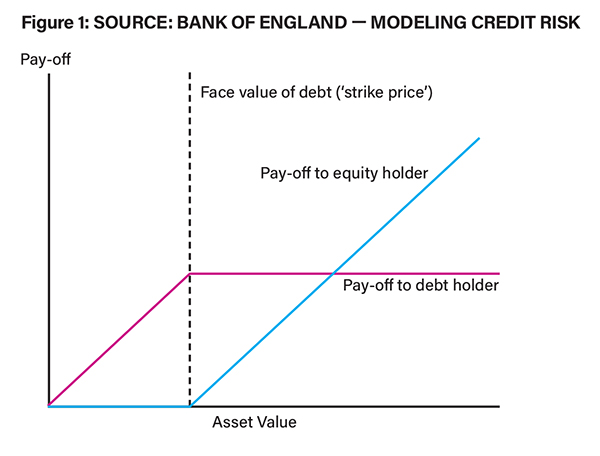
On a single transaction level, pricing for the deal must at least cover the expected loss, capital costs and the direct costs associated with the production of the ticket, such as labor, systems and direct allocations. The surplus covers overhead and determines the ultimate profitability of the deal (measured as contribution margin, RoE, EVA, net interest margin or similar). Assuming a first lien on the financed equipment, the payoff profile for a loan or finance lease is as follows. (See the pink line in Figure 1).
Recovered amounts first go to the secured debt holder. While the downside risk is limited to the net recovery value of the asset, the upside is also limited to interest and fee income.
In simple terms, in traditional lending, a deal is underwritten with the general expectation that each ticket on its own is profitable based on these standard modeling principles. Because upside is limited, downside risk is managed conservatively.
However, pay-per-use models have different risk-reward profiles compared to traditional lending. Legacy loan and lease credit models have limited compatibility with a pure PPU offering. A different form of economic modeling is required, and the strategic question should be asked first: What product do I want to offer and why? Then, a holistic risk management and pricing framework should be created specific to PPU.
A PPU offering affects all areas of the lessor’s business. It cannot be developed by individual departments in isolation. There are challenges and dependencies, which can best be overcome in a joint work group where each stakeholder is equally invested. Everything is interconnected: a risk-driven change in the product offering, for example, can affect pricing, operations and accounting.
Like with every new product development, it should not be self-serving or follow a trend, but a conscious decision to address a customer’s need. Development should be customer-centric, ideally a co-development with trusted partners, applying design thinking.
However, there are scenarios where PPU appears to be difficult to implement for the simple reason that the lessor (or third-party investor) wants to recoup its investment with a reasonable level of assurance. Someone needs to pay the bill. Ask two key questions: Who sits at the table, and what is the customer solving for? Let’s look at two illustrative examples.
Example No. 1: A manufacturing company is looking for a PPU offering for an additional machine tool. All other machine tools of similar configuration on the production floor are traditionally financed or owned. The company is looking to add capacity through a PPU offering to have a spare machine in case of a defect and to address unexpected demand spikes.
The company has an information advantage in its order book, capacities and demand patterns and might be able to control and minimize usage by flexibly shifting between several machines or adjusting shift plans. At the end of the day, as a rational market participant, the company is expected to manage and limit the usage of the PPU equipment. After all, the company is looking for a cheaper alternative to traditional financing because the ROI otherwise is insufficient.
On the other side, the lessor is looking to recoup the investment in the equipment and earn interest. How would the parties ever find success together with a mutually beneficial solution?
Example No. 2: A lessee is requesting a PPU quote for a large 3D printer. The lessee is a start-up. If the business is taking off as planned, the lessee would be willing to pay more overall compared to traditional financing. However, if the business does not scale as planned, the founder does not want to be burdened by fixed costs.
This sounds more like a good PPU use case. However, the lessee is essentially looking for a partner to share the entrepreneurial risk of a start-up enterprise. The PPU risk-reward profile in this case suddenly looks more like a venture capital investment. A traditional debt lender/lessor might not be equipped for the challenge.
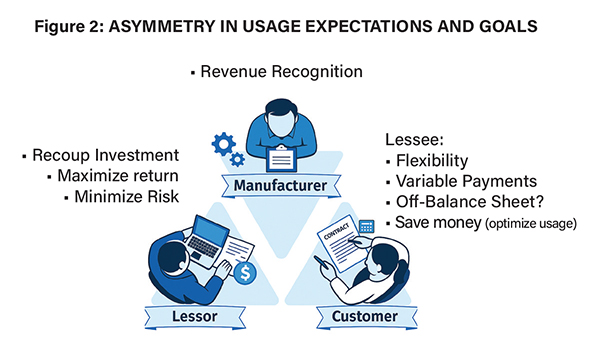
In either scenario, the lessor might be tempted to address such uncertainties with “defensive pricing” (high fees per use) or a firm usage floor. However, if the primary goals between lessor and lessee are misaligned, it will be difficult to create a good value proposition. A pure PPU model is not the answer for lessees that predominantly want to save money or place entrepreneurial risks with a traditional debt financing institution (See Figure 2).
A Change of Perspective: Alignment of Goals as a Success Factor
The perspective changes if we add three aspects to the consideration:
- A PPU offering is a partnership
- Not the lessee, but a fourth party directly drives the usage
- Both the lessee and lessor benefit from higher demand specifically for the financed device
It becomes a different story when we stipulate that a fourth party, such as a consumer or patient, determines the usage to a larger degree. If the PPU model is set up accordingly with shared proceeds and no arbitrage opportunities, the lessee and lessor now have a joint and aligned interest to drive up traffic, usage or output to maximize return for both parties at the same time. The consumer or patient drives the usage and is not concerned with the business set-up in the background. The investment decision and the usage decision are made by different parties.
For example, an operator and the equipment specialist could team up to install EV charging stations. There is data to model demand, density of chargers already existing in the area, expected growth of the automotive EV share, energy prices, etc. The parties agree on the operational model and marketing plan. Revenue sharing initially would over proportionally reward the capital provider at least until the investment is recovered.
What are the goals of the involved parties?
Manufacturer:
- Revenue Recognition
- Stick factor
Lessor:
- Recoup Investment
- Earn interest / fees
- Minimize Risk
Customer:
- Flexibility
- Variable Payments
User:
- Consumer or patient, drives usage decision
- Variable payments
- No relationship to Lessor
Examples of areas that could be fertile ground for a pure PPU offering:
• EV charging stations
• Digital imaging in healthcare
• Vending machines
• Cloud-based IT
• Energy production
In these cases, consumers or patients are the drivers of usage, and data is available for statistical modeling. This requires a paradigm shift, though. The risk-reward profile for the lessor has elements of venture capital, equity or mezzanine investment and no longer that of traditional credit. The difference to venture capital is that the cash flows are tied to specific equipment and not the entire enterprise. Managing such a PPU offering requires a substantially different risk management and pricing framework compared to traditional credit risk. Regulated banks and their equipment leasing subsidiaries might be at a disadvantage compared to independent lessors in this respect.
What are some of the key components?
Paradigm Shift
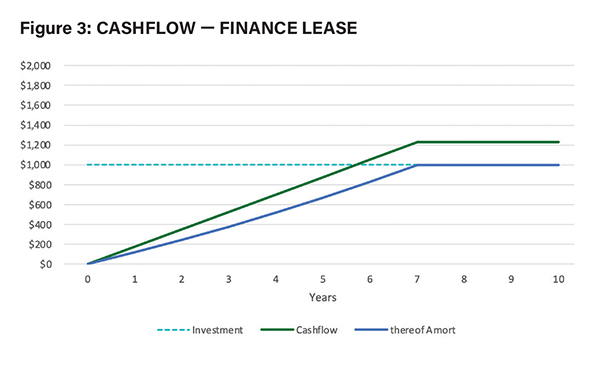
A simplified loan/finance lease cashflow profile looks like Figure 3. Over time, amortization and interest are collected, ultimately resulting in the full recovery of the investment plus interest. The interest component is known in advance, and therefore the expected maximum profit of the contract.
Since amortization payment and equipment value curves are known, the collateral coverage gap/surplus over time can be modeled easily as well.
A simplified pure-form PPU profile looks different in three ways:
- Full repayment of the investment is not contractually assured.
- The collateral coverage gap/surplus over time can only be modeled based on usage assumptions.
- The upside is likely limited by physical maximum machine hours or output, but it should be substantially higher than the interest component of a regular loan or lease.
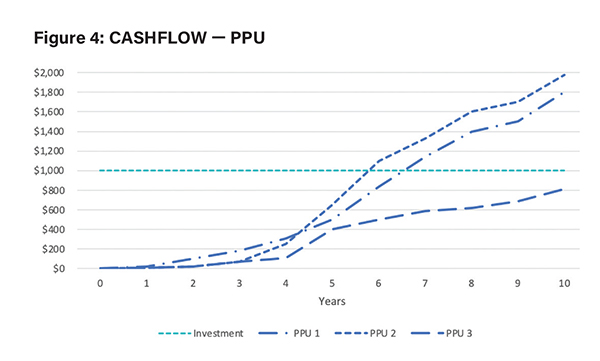
The PPU cash flow profile could look like Figure 4, a simplified graph to illustrate the variability of possible cash flows (no distinction made between interest and amortization and not intended to reflect the P&L treatment).
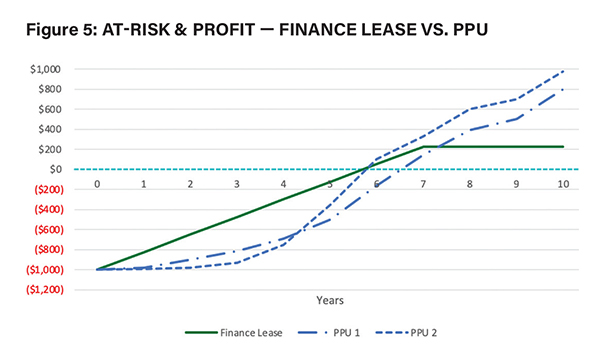
A high-quality PPU value proposition entails the risk that less than planned usage occurs, and the lessor does not recoup the investment in the expected initial time frame. If the lessor is not ready to take this risk, it will eventually result in the negotiation of terms and conditions, which dilute the PPU value proposition (e.g., by adding a floor or prohibitively high usage charges).
However, depending on the negotiated terms, the upside for the lessor can be higher compared to a traditional loan/lease, as illustrated in Figure 5, a simplified graph to illustrate the potential additional earnings potential, assuming slower amortization in the beginning.
Changes:
- Acknowledge that the risk/reward profile differs from traditional loan/lease underwriting
- Manage asset pools instead of individual equipment
- “Partner up” with lessees to jointly drive and benefit from usage/traffic
- Underwrite a business model, not a balance sheet
Managing asset pools instead of individual assets is a key change. Individual asset returns could be negative at times, as long as the pool of assets under PPU contracts creates a higher yield than would be the case in aggregate for traditional financing.
The lessor’s organization needs to adjust accordingly. While the lessor retains the ownership rights to the equipment, the pay-off profile is more closely linked to the lessee’s entrepreneurial success. The expected return is higher compared to a loan/lease product, but so is the volatility of returns.
Among the strategic decisions to be made are:
- How much usage risk can the organization take? How much entrepreneurial risk does the lessor want to take? Would this include start-ups?
- Should these activities be housed in a separate entity with separate rules and funding? Or is the preferred model one in which the lessor structures the transaction and takes some synthetic credit risk (leveraging asset, underwriting and technical expertise), while a third party, such as an insurance company or other specialist investor, provides the risk capital and retains the upside?
What does it take to bring a successful PPU solution to market?
- Analyze where it makes sense to play. What is the environment for success?
- Create the management framework.
- Create a growth mindset culture.
- Train the organization.
- For the actual product development, begin with the customer and apply design thinking.
Ask these key questions:
- Motive: What exactly is the customer requesting, and which problem is the customer trying to solve?
- Benefit: For what is the customer willing to pay or pay extra for?
- Which vendor partner might be interested in taking some initial usage risk in exchange for the benefit of innovation and the strong marketing value associated with it?
Start with a scalable offering, a product configuration that can fit different types of equipment and a larger subset of customers.
Stay away from areas that appear not to be truly conducive to PPU offerings:
- Sectors with limited statistical data
- Equipment that is not essential for the lessee’s operations
- Production equipment with high output constraints, such as long set-up times or low usage variability
- Equipment with relatively high connectivity costs (edge device/software)
- Highly cyclical sectors
- Lack of partnership and aligned interests with the lessee/operator
Create the Management Framework:
Risk: Make adjustments where necessary to credit risk, asset risk, interest rate risk and operational risk frameworks. Create a framework for usage risks and add underwriting know-how. Set limits. Define risk appetite. Adjust monitoring and reporting routines accordingly. This applies to the single-transaction level as well as the portfolio level. At the portfolio level, modeling the correlation of usage risks appears to be a relatively green field, but it cannot be ignored.
Treasury: Refinancing variable, not predetermined, payment streams.
Legal: Develop standard contractual terms for PPU.
Sales/Marketing: Decide how to bring the product to subsets of the market.
Operations and Accounting: Ensure data integrity in the flow of data from the asset to the lessor and operationalize the product within the organization.
Conclusion
It seems like PPU models have been slow to take off in traditional equipment finance. This is likely due to the constraints of traditional debt risk management and pricing policies. However, the value proposition for the lessee is attractive and mastering the discipline would be a true diversification factor.
Technological progress further supports and improves the PPU value proposition. The permeation of IoT connectivity expands the scope of assets available for PPU offerings. In addition, there are already several prototypes or products in various sectors of finance for blockchain-based contract execution. So, in the future, usage data will not only be automatically available through IoT interfaces, but the contract could be automatically settled without issuing a paper invoice.
And while this is certainly not on the horizon yet, usage risks could even become a new investment class. There are instruments to hedge weather and longevity risks, including crop insurance. On prediction platforms, you can bet on virtually anything, including whether Costco will raise the price for the hot dog combo. So, somewhere should be a party with the appetite to invest in usage risk in a partnership with the lessor. •
1Kampshoff, Philipp, et. al., “Paving the way for off-highway-equipment customers,” McKinsey, Nov. 18, 2025.
Editor’s Note: The views expressed herein are the personal views of the author.
Ralf Enders is a vice president at Wells Fargo Equipment Finance.