

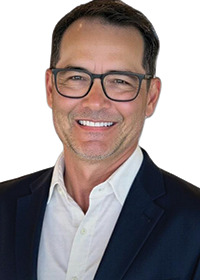
Rod Versteegh did not seek the spotlight. But when it comes to the business of equipment finance — the relationships, the strategy, the long view — he speaks with the quiet authority of someone who has been doing this for more than 30 years and is nowhere near finished.
After more than two decades at DLL, where he helped build and then globalize what became the company’s largest business unit, Versteegh stepped away into a brief retirement. It didn’t take. In September 2025, he emerged as the new head of equipment finance at First Citizens Bank. He is quick to credit his predecessor, Mike Jones, with leaving the operation in strong shape. But Versteegh has plans to build upon the strong foundation, and it is already in motion.
Money Is Homogeneous. Relationships Are Not.
Ask Versteegh what the most enduring lesson of his career has been, and his answer comes without hesitation: relationships.
“Money is somewhat homogeneous,” he says. “Everybody competes selling money within a few basis points of each other. What it boils down to — the common denominator of being successful — is really the relationships that you build throughout your career: with customers, with dealers, with manufacturers. People want to deal with people they can trust. It’s not even just about the business. It’s about having that personal connection and relationship as well.”
That philosophy has roots in his early career. Versteegh traces much of his leadership formation to Bill Hall, a mentor he first encountered at AT&T Capital who would later recruit him to a leasing company in Portland, OR — Hall’s home territory and Versteegh’s birthplace. Hall took him from credit analysis into sales and eventually brought him to DLL, where the real scaling would begin.
“Bill basically told me: the success of you and the business will be who you surround yourself with,” Versteegh recalls. “Give people the vision and the strategy. Work with them. Provide the tools, guidance and support for them to be successful. And treat people the way you want to be treated.”
He still keeps in contact with Hall. And the principles, he says, still apply.
Why First Citizens?
When the opportunity at First Citizens Bank came along, Versteegh did his homework. He knew the CIT and Silicon Valley Bank acquisitions had given the bank a significant footprint, but he wanted to better understand the character of its leadership and ownership.
“I did my research and was pretty impressed by First Citizens’ long family history — over 125 years as a bank,” he says. “They have a long-term view. Even though they’re publicly traded, they think well beyond quarter to quarter or even year over year. And they walk the talk when it comes to culture. Family members of the board come into the office, shake everybody’s hand, and are genuinely interested in getting to know all associates in every department at every level. They’re just not what you would expect within a bank of its size.”
The cultural alignment mattered as much as the opportunity. Versteegh found in First Citizens a reflection of the leadership ethos he had cultivated over decades — one grounded in stability, trust and a longer investment horizon than most public companies allow.
Also part of the appeal: the bank’s full suite of products. “In addition to equipment financing and leasing, there are depository accounts, cash management, commercial banking, wealth management, real estate and insurance,” he notes. “A lot of other banks don’t connect those things with equipment financing. We’re making a concerted effort to make these products available for an end-to-end solution to OEMs, dealers and end users.”
Building on What Jones Built
Versteegh is generous in his assessment of Jones, whose tenure transformed First Citizens’ equipment finance operation into a Monitor 100 pacesetter. “Mike did a real nice job setting everything up and handing off in a very coordinated manner. He built a team of great people, and the culture here is pretty amazing,” he says.
The foundation he inherited includes strong programs in office imaging and technology as well as robust dealer relationships in the construction and specialty vehicle space. Versteegh’s instinct is to preserve and build upon that, not reinvent it.
Where he is planting his own flag is in three strategic priorities: floor planning, rental fleet financing and end-of-term asset management — capabilities he views as essential to securing the kind of OEM programs that defined his past success.
“Floor planning and rental fleet are critical,” he explains. “If you want to win OEM programs in segments such as agriculture, construction, golf and turf — the hard asset arenas — you need to offer an end-to-end product. Combine that with our existing strong presence in office imaging and technology, and our growing presence in the healthcare market, and we have a well-diversified portfolio where we can look to service the needs of all our customers.”
Asset management at end of term is equally important to him — not just for the bank’s portfolio protection, but as a differentiator with OEM partners. “OEMs and dealers want to know that their equipment and their brand is protected and that they have visibility to what happens to it at end of term,” he says. “We partner with them through the full life cycle — manufacturing to distribution to end user and back. They get the first right to purchase that equipment off lease. And we can tell them about their customer’s behavior — are they ready to upgrade? It’s a genuine partnership, not just a transaction.”
On Leadership: No Ego, Full Accountability
Versteegh’s leadership philosophy is one he has honed across decades and continents, and it traces back to those early lessons from Bill Hall. The shorthand: clear the path, set the vision, hold people accountable — and don’t ask anyone to do something you wouldn’t do yourself.
He was struck by how closely Jones’ approach mirrored his own. “I thought, being an Army Ranger veteran, Mike would be the type to direct orders and people would jump when he spoke. It was completely opposite. Mike was very easygoing. People loved working for him. They would walk through walls for him. And it was because his style was to clear the path so people could do their jobs. That’s also really how I operate.”
The View from Here: Headwinds, AI and the Next Generation
Asked about the single biggest threat to equipment finance growth over the next 18 months, Versteegh points to geopolitical uncertainty — oil prices, inflation and tariff pressures — that have dampened the expansionary appetite building earlier in the year.
“When I went to ConExpo and AED before the conflict escalated, sentiment was really strong,” he says. “Then oil prices spiked, and people started pumping the brakes, waiting to see what happens. They’ll always replace obsolete equipment — that’s a given. But expansion purchases? They’re going to hold until the picture is clearer.”
His sleeper opportunity: AI and automation — not just as operational tools, but as equipment to be financed. As manufacturers integrate telematics and autonomous functionality into heavy machinery, Versteegh sees a significant financing challenge and opportunity emerging. “The challenge is how do you put a value on an AI software or AI bolt-on? It’s financing an intangible product. But the efficiency gains are real, and the industry needs to figure out how to quantify that value and price it accordingly.”
Within his own operation, AI is already in use — but carefully. “We have bots helping our associates with routine tasks so they can focus on the more complex, customer-facing conversations. I’m not comfortable with customer-facing AI yet. People still want to talk to a person when things get complicated. But down the road — maybe closer than we think — there’s going to be a time when people don’t even know they’re talking to a computer.”
On the industry’s long-running struggle to attract younger talent, Versteegh is candid about what the industry can’t offer — and optimistic about what it can. “I don’t know how to make this industry cool,” he says with a laugh. “But it’s a long-standing industry. It’s one of the fabrics that holds everything together. What I think is genuinely exciting for younger generations is the opportunity to connect emerging technology with what is essentially an old-school business model — and take it somewhere it’s never been.”
For Versteegh, the appeal of First Citizens Bank — its stability, long-term orientation and family-led continuity at the top — is not incidental to the job. It’s the whole point.
“You see a lot of finance companies come and go, change their management, change their philosophy, and strategy,” he says. “I don’t see that happening here. The family is very active and involved in the overall vision, strategic execution, and maintaining the core values of the bank. It’s a very stable organization, very committed to the industries they serve. That’s a long-term play. And that’s exactly how I think about this business.” •