

This year’s Monitor 101+ shrank again, but the results grew. The group dropped to 23 reporting companies from last year’s 25. Yet for the companies that remained, 2025 was a year of recovery rather than retreat. As a group at year-end 2025, the Monitor 101+ companies reported $3,386.1 million in net assets, $2,538.7 million in new business volume and 575 employees — increases of 17.7%, 22.6% and 8.7%, respectively, year over year.
The Top Five
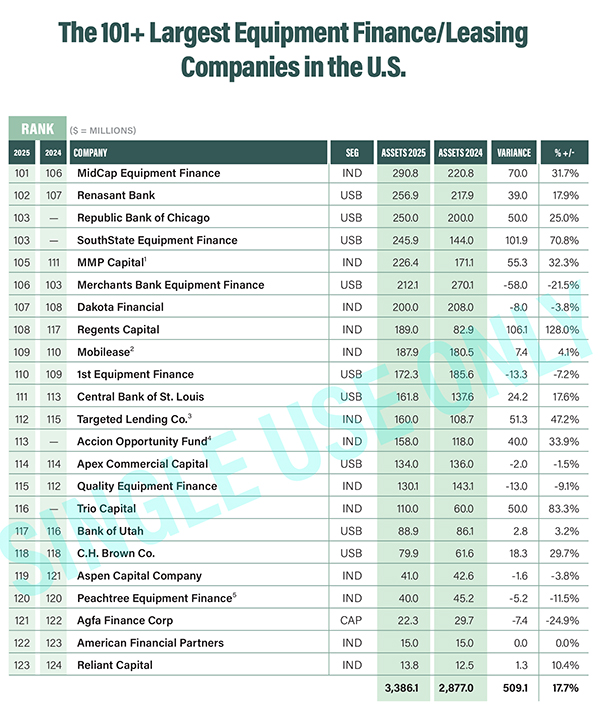
Among the top five Monitor 101+ companies ranked by net assets, growth was the theme. No. 101-ranked MidCap Equipment Finance led with net assets of $290.8 million, up $70 million, or 31.7%, year over year. Renasant Bank followed at No. 102 with $256.9 million, growing 17.9%, or $39 million. No. 103-ranked Republic Bank of Chicago, new to this year’s ranking, reported $250 million, up $50 million, or 25%, from a year earlier. SouthState Equipment Finance, also new to the ranking, came in at No. 104 with $245.9 million, posting the group’s steepest growth rate at 70.8%, or $101.9 million. And No. 105-ranked MMP Capital reported $226.4 million in net assets, up 32.3%, or $55.3 million. Unlike last year, when gains and losses were evenly split among the top five, every company in this year’s top tier grew its portfolio.
Asset Trends by Segment
From a net asset perspective, the Independents overtook the U.S. Bank Affiliates as the largest segment by number of companies and by dollar volume. Independent companies’ total assets rose from $1,408.4 million to $1,762 million, an increase of $353.6 million, or 25.1%, year over year. Of the 13 companies in this segment, eight reported growth, four declined and one was flat, pushing the segment’s share of the Monitor 101+ universe from 49% to 52%.
The U.S. Bank Affiliates also posted solid gains, with total assets climbing from $1,438.9 million to $1,601.8 million, an increase of $162.9 million, or 11.3%. Of the nine companies in this segment, six grew and three declined. Even so, because Independents grew faster, the U.S. Bank Affiliates’ share of the Monitor 101+ universe slipped from 50% to 47.3%.
The Captives, now down to a single reporting company, saw assets fall from $29.7 million to $22.3 million, a decline of $7.4 million, or 24.9%. The segment’s share of the Monitor 101+ universe shrank to just 0.7% of total net assets.
Top Five ENI Gainers
The Monitor 101+’s top performers in ending net investment (ENI) growth were led by Regents Capital, which surged by $106.1 million, a 128% increase — by far the largest percentage gain of any company in the ranking. SouthState Equipment Finance followed with a $101.9 million gain, or 70.8%. MidCap Equipment Finance added $70 million, while MMP Capital and Targeted Lending Co. gained $55.3 million and $51.3 million, respectively.
Top Five Percentage Gainers
In terms of percentage growth, Regents Capital again led the field at 128.0%, followed by Trio Capital at 83.3% and SouthState Equipment Finance at 70.8%. Targeted Lending Co. posted a 47.2% gain, and Accion Opportunity Fund rounded out the top five at 33.9%.
$100MM Club
This year’s $100 Million Club welcomes two new entrants who crossed the $100 million threshold in net assets. Regents Capital vaulted from $82.9 million in 2024 to $189.0 million in 2025. Trio Capital climbed from $60 million to $110 million.
YE 2026 ENI Forecast
The 2026 forecast for Monitor 101+ net assets projects continued strong growth, with total assets expected to rise from $3.39 billion in 2025 to nearly $4.7 billion, an increase of 38.7%. Of the 22 companies that provided a forecast — representing 95.6% of the panel’s total assets — 13 anticipate growth and nine expect no change; none foresee a decline. The projected increase is driven in part by outsized growth expectations at a handful of firms, a reminder that forecasts at the high end of the range can swing the group total considerably.
While net asset growth tells one story, origination volume reveals another: a broad-based rebound after last year’s pullback.
New Business Volume: Broad-Based Growth
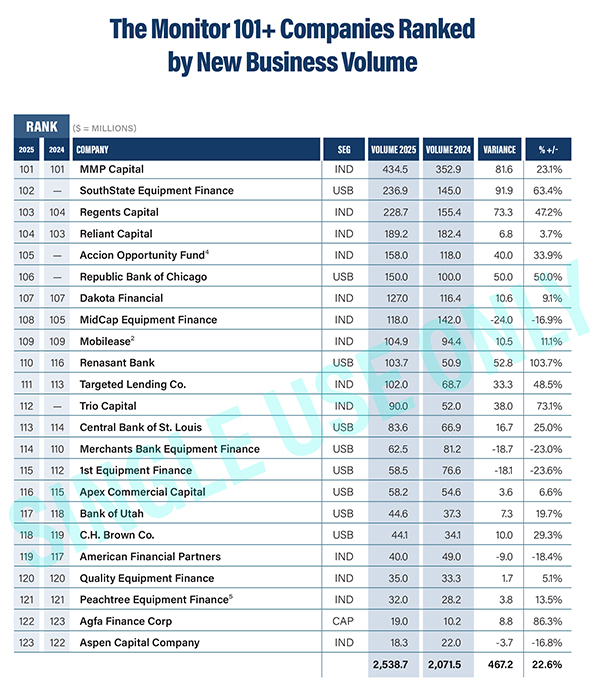
New business volume across the Monitor 101+ companies totaled $2,538.7 million in 2025, up 22.6% from $2,071.5 million in 2024 — a reversal of last year’s 5.5% decline. Eighteen companies increased volume while five posted declines; none were flat.
The Top Five — NBV
Leading the Monitor 101+ in new business volume was MMP Capital, with $434.5 million, up 23.1% year over year. SouthState Equipment Finance surged to second with $236.9 million, a 63.4% increase. Regents Capital ranked third at $228.7 million, up 47.2%, followed by Reliant Capital at $189.2 million, up 3.7%. Accion Opportunity Fund, new to the ranking, rounded out the top five with $158 million.
Segment Performance — Volume
The U.S. Bank Affiliates posted the sharpest turnaround, with originations climbing 30.2% from $646.6 million to $842.1 million — the largest dollar and percentage gain of any segment and a marked reversal from last year’s 11.8% decline. Seven of the segment’s nine companies increased volume. The segment’s share of total Monitor 101+ volume rose from 31.2% to 33.2%.
Independents also grew, with volume rising 18.6% from $1,414.7 million to $1,677.6 million. Ten of 13 companies increased originations. Because bank affiliates and captives grew faster, however, the Independents’ share of total volume slipped slightly, from 68.3% to 66.1%.
The Captives, though still a small share of the market, posted the steepest percentage increase of any segment: volume rose 86.3% from $10.2 million to $19 million, lifting the segment’s share of total Monitor 101+ volume from 0.5% to 0.7%.
Top Performers
Several companies stood out in 2025 for notable year-over-year volume shifts. SouthState Equipment Finance led all gainers in dollar terms with a $91.9 million increase, up 63.4%. MMP Capital added $81.6 million (23.1%) and Regents Capital grew by $73.3 million (47.2%). On a percentage basis, Renasant Bank more than doubled its volume, up 103.7%, while Agfa Finance Corp and Trio Capital posted gains of 86.3% and 73.1%, respectively.
2025 Retrospective: Tariffs, Competition and a Market Finding Its Footing
Monitor 101+ companies across all segments described 2025 as a year of adjustment, shaped by tariff uncertainty, aggressive competition and, for several firms, internal transitions. Independent lenders felt the competitive squeeze most acutely: one large- ticket independent noted that “too much money was chasing too few deals,” with pricing made more aggressive by falling rates and a robust ABS market. Others in the space echoed a choppy economy and irrational competitors as recurring themes.
Several independents also spent 2025 on internal transformation. One company completed a year-long project to bring servicing back in-house, while another restructured its sales team and ran parallel software systems to verify new platforms were working correctly, all while trying to maintain customer service through the changes. A recurring note among smaller independents was simply the challenge of managing growth — balancing scale with culture, quality and financial stability.
U.S. Bank Affiliates described a mix of integration work and market friction. One lender, still adjusting after a 2024 bank merger, spent the year aligning its in-house equipment finance platform with new leadership, adjusting credit policies and territories along the way, while also contending with softer demand in certain sectors and a more crowded field of non-traditional finance providers. Another noted a slow start to the year before finishing strong, alongside minor regulatory friction and the challenge of scaling headcount without sacrificing talent quality. Elsewhere, fierce competition and soft demand were cited as the primary headwinds, and one lender candidly described the ongoing challenge of sorting through a flood of low-quality broker submissions to find deals worth pursuing — while also noting that competitors exiting the market had ultimately worked in its favor, as had its own decision to exit a large state market amid regulatory constraints.
2026 Outlook: Direct Origination, Automation and AI
Looking ahead, Monitor 101+ companies’ priorities cluster around three themes: deepening direct origination capabilities, modernizing technology and operations and managing a still-uncertain economy.
Independents are focused on origination growth and channel mix. One growing independent said its 2026 priority is increasing the share of direct originations in its total volume, now that it has the staff in place to move beyond reliance on indirect channels. Others are targeting larger-ticket and specialty equipment to grow their portfolios faster, while several companies — across ticket sizes — cited a push toward electronic documentation and e-vaults to speed up closing. New technology implementation and improved customer-facing systems were also common priorities, alongside more traditional goals like marketing and, for at least one company, simply underwriting efficiently as credit profiles weaken.
U.S. Bank Affiliates are focused on staffing and efficiency. Several cited the need to build organizational depth and hire the right talent to support direct origination growth within their bank’s footprint, while others pointed to operational efficiency and new loan origination systems as top priorities. One lender specifically cited plans to integrate more AI-driven automation to improve speed and free staff to focus on strategy — part of a broader trend in this year’s data: 41% of responding companies (nine of 22) report using AI in some part of their business, most often in credit and risk management, operations and data and analytics.
Challenges & Concerns
According to survey data from Monitor 101+ companies, the economy and capital spending trends are this year’s dominant concern, cited by 52% of respondents — up sharply from 32% last year. Credit quality of customers ranked second at 24%, up from 16%, as lenders continue to watch for signs of stress among borrowers.
Margin compression followed at 14%, while competition and the geopolitical environment each drew 5% of responses. Notably, competition’s share fell precipitously from 20% a year ago. Regulatory constraints and access to quality capital, cited by 12% and 8% of respondents last year, registered no mentions this year at all.
As always, we appreciate the time and effort of the equipment finance companies that participate in our annual survey. The Monitor 101+ would not be possible without the ongoing cooperation of the equipment finance community. •
Rita E. Garwood is editor in chief of Monitor.