

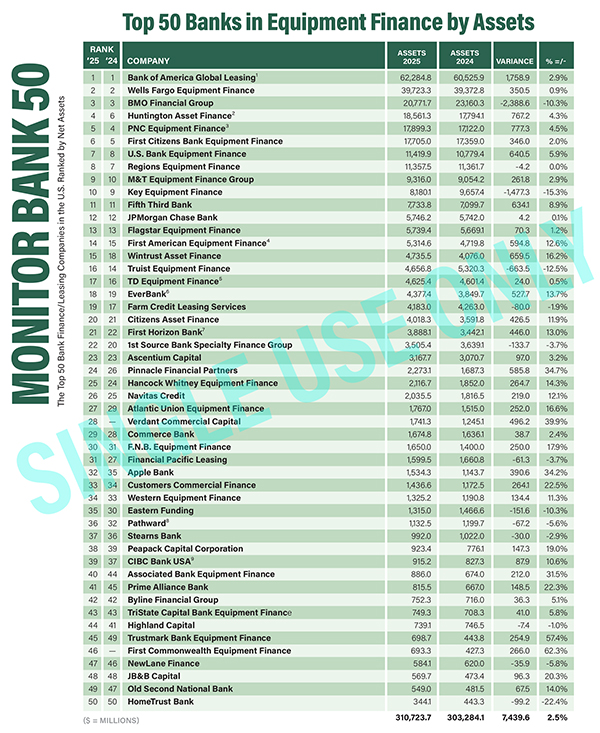
Monitor’s 2026 Bank 50 reported $310.7 billion in year-end 2025 net assets, up 2.5% from $303.3 billion a year earlier, and $104.6 billion in 2025 new business volume (NBV), up 8.7% from $96.2 billion in 2024. Both measures reversed the slight declines reported last year. Portfolios grew at 37 of the 50 companies, and 36 increased volume. Comparisons use 2024 figures as restated by participants, and a handful of companies report fiscal years ending in September or October.
The Top 5 — ASSETS
Bank of America Global Leasing led again at No. 1 with $62.3 billion in assets, up 2.9% and equal to 20% of the Bank 50 total. Wells Fargo Equipment Finance held No. 2 with $39.7 billion, a 0.9% gain. BMO Financial Group stayed at No. 3 even as its assets fell 10.3% to $20.8 billion.
The shake-up came below them. Huntington Asset Finance climbed from No. 6 to No. 4 on 4.3% growth to $18.6 billion (its 2024 figure was revised to include off-balance-sheet syndicated managed assets). PNC Equipment Finance slipped to No. 5 despite a 4.5% increase to $17.9 billion, and First Citizens Bank Equipment Finance moved from No. 5 to No. 6 with $17.7 billion, up 2%.
Smaller Players Gain Ground
Growth was concentrated outside the biggest names. The top 10 grew assets just 0.5%, while the remaining 40 companies grew 7.4%, lifting their market share to 30.1% from 28.7%. The pattern was starker in volume, where the top 10 gained 4% and the other 40 surged 19.3%.
Noteworthy Performances
Several companies posted standout gains. First Commonwealth Equipment Finance, new to the ranking at No. 46, grew 62.3% to $693.3 million. Trustmark Bank Equipment Finance rose 57.4% to $698.7 million, moving from No. 49 to No. 45. Verdant Commercial Capital, also new to the ranking after its acquisition by Axos Bank, entered at No. 28 with $1.7 billion, up 39.9%. Pinnacle Financial Partners grew 34.7% to $2.3 billion, Apple Bank 34.2% to $1.5 billion and Associated Bank Equipment Finance 31.5% to $886 million.
Top 5 — New Business Volume
Bank of America Global Leasing led in volume, up 5.8% to $18.4 billion. Wells Fargo Equipment Finance remained No. 2, rebounding 9.1% to $13.2 billion after last year’s 17.5% drop. Huntington Asset Finance rose from No. 6 to No. 3 on a 13.2% increase to $7.4 billion, and PNC Equipment Finance held No. 4 with a 9.7% gain to $7.2 billion. U.S. Bank Equipment Finance jumped from No. 8 to No. 5, growing 6.5% to $4.7 billion.
BMO Financial Group dropped from No. 3 to No. 6 after a 9.7% decline to $4.5 billion, and First Citizens Bank Equipment Finance fell from No. 5 to No. 7 as volume decreased 13.1% to $4.1 billion.
Standout NBV Performers
Apple Bank grew volume 175.9% to $1.1 billion, rising from No. 35 to No. 26. Peapack Capital Corporation more than doubled its volume, up 152% to $441 million. Pinnacle Financial Partners rose 51.7% to $1.4 billion, moving from No. 26 to No. 19, and Prime Alliance Bank climbed from No. 45 to No. 34, up 49.1% to $557 million.
Not everyone shared in the gains. Fourteen companies reported lower volume, including Eastern Funding (down 32.6%) and CIBC Bank USA (down 19.7% after last year’s surge).
Direct-to-end-user business remained the dominant origination channel at 54.5% of volume, essentially flat from 54.6% in 2024. Indirect, or buy-desk, volume grew fastest, up 20.7% to $14.5 billion and 13.9% of the total, from 12.5%.
Equipment Finance on the Balance Sheet
New this year, Monitor measured how much of each parent bank’s balance sheet its Bank 50 unit represents, using year-end 2025 FDIC call report data. Overall, the 50 equipment finance operations account for 4.4% of their parents’ total loans and leases and 2.3% of total assets.
The shares vary widely. At Prime Alliance Bank, equipment finance is nearly the whole franchise: its $815.5 million portfolio equals 95.6% of loans and leases and 76% of assets. Western Equipment Finance (60% of loans), 1st Source Bank Specialty Finance Group (49.7%) and Stearns Bank (33.8%) lean heavily on equipment leasing and finance.
Among the larger players, equipment finance is a meaningful but minority business. It equals 12.3% of loans at Huntington Asset Finance, 11.9% at First Citizens Bank Equipment Finance and 11.8% at Regions Equipment Finance. The two largest units, Bank of America Global Leasing and Wells Fargo Equipment Finance, represent 5.3% and 4.2% of their parents’ loans, while JPMorgan Chase Bank sits at 0.4%.
Fourteen companies derive 10% or more of their parent’s loans and leases from equipment finance; the median across all 50 is 7.2%. That group includes two of the year’s fastest-growing originators, Peapack Capital (14.8%) and Apple Bank (11.5%), both of which more than doubled volume.
U.S. Banking Overview
FDIC-insured institutions posted $90.1 billion in net income in Q2/26, up $9.7 billion, or 12%, from Q1/26, according to the FDIC’s “Quarterly Banking Profile.”1 Return on assets was 1.37%, and net interest margin rose one basis point to 3.32%.
Loan and lease balances grew 1.8% from the prior quarter and 6.8% from a year earlier, led by lending to non-depository financial institutions and margin loans. Asset quality improved, with past-due, non-accrual and net charge-off rates all declining from the prior quarter. The number of institutions on the problem bank list fell by seven to 47.
Staffing
Of the 49 companies reporting year-over-year staffing changes, 28 increased headcount, 19 decreased it and two were unchanged, compared with 22 increases and 24 decreases a year earlier. Total employees at those companies fell 4.2% to roughly 9,200.
Looking Back at the Forecasts
Bank 50 participants have tended to be conservative. A year ago, they projected 1.6% portfolio growth and 4% volume growth; they delivered 2.5% and 8.7%. Entering 2026, the outlook was upbeat again. Among respondents, 36 of 43 expected portfolio growth, 36 of 41 expected higher originations and 35 of 45 planned to add staff. Weighted averages called for net assets to grow 4.6% and volume 5.6%.
Monitor thanks all participants and their staff members for providing the survey data we rely on to produce this report. As always, we welcome your feedback and commentary. •
1“Quarterly Banking Profile – 2Q 2026,” FDIC, Sept. 1, 2026.
Rita E. Garwood is editor in chief of Monitor.