
Despite rising rates, competitive pressure, and lingering economic uncertainty, the Monitor 100 companies posted modest gains in assets and originations in 2024. With hiring expected to rebound and a renewed focus on technology, efficiency and disciplined growth, the equipment finance industry is cautiously preparing for a more expansive 2025.
The 2025 Monitor 100 companies reported net assets of $568.1 billion, new business volume of $205.6 billion and 27,128 employees.
The group’s collective net assets grew by 2.0% in 2024, down from the previous year’s 5.8% growth rate. Seventy-seven companies expanded their portfolios, adding a total of $25.4 billion in assets. Meanwhile, 23 companies saw their net assets decline by a combined $14.3 billion. The result: a collective gain of nearly $11.1 billion. New business volume rose by 2.5% in 2024, adding a nearly $5.1 billion year-over-year increase in originations across the Monitor 100 companies. While 38 companies reported a combined decline of $9.2 billion, this was offset by $14.3 billion in gains from the other 62, resulting in another year of modest growth despite headwinds affecting nearly 40% of the group.
STILL FEELING THE SHOCKWAVES OF THE BANKING CRISIS
In 2023, many banks pulled back from the Monitor 100, with nearly 60% reporting smaller equipment finance portfolios and 72% reducing new business volume. By 2024, banks cautiously returned to the space — 63.6% reported increases in net assets and 49.1% reported upticks in originations. Still, the group saw slight year-over-year declines overall in both assets (down 1.6%) and new business volume (down 1.2%). For U.S. Bank Affiliates, 2024 was defined by operational and organizational pressure. Staffing shortages and leadership turnover created friction just as many institutions attempted to modernize outdated systems and accelerate automation. Strategic realignments — such as repositioning business units — added complexity, while compliance demands grew heavier in the wake of the 2023 banking crisis. Liquidity concerns persisted, and many institutions tightened capital management strategies in response to a more conservative regulatory environment. Some of the most challenging credit issues arose in transportation, where rising delinquencies and credit migration led banks to become more cautious. Still, several institutions adapted effectively, shifting toward variable-rate lending, emphasizing pricing discipline and focusing on higher-quality credits to preserve profitability despite a fiercely competitive environment.
INDEPENDENTS FUEL EXPANSION AMID FIERCE COMPETITION AND CAPITAL STRAINS
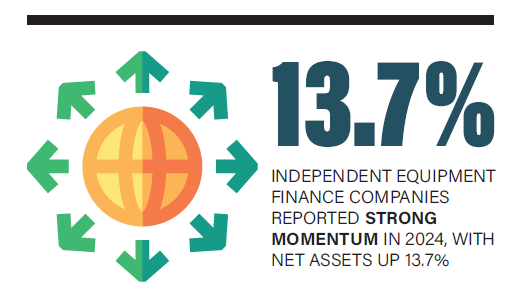
Independent equipment finance companies reported strong momentum in 2024, with net assets up 13.7% and new business volume up 16.8%. However, that growth came with significant hurdles. The most significant pressure point was margin compression, driven by aggressive pricing from new entrants and fierce competition for originations. Independents also faced operational strain, scaling fast to keep pace with demand while trying to maintain underwriting discipline and customer service. While some firms achieved major wins, like launching inaugural asset-backed securitizations (ABS), others syndicated more deals due to capital access challenges.
Credit performance was mixed. While mid-to-large ticket sectors, such as aviation, held up well, the trucking sector weighed heavily on many portfolios, with one firm reporting the highest aging and default levels since 2010. Several independents cited difficulty balancing hypergrowth with risk oversight, especially as rising volumes tested internal infrastructure.
Yet, despite the challenges, many independents ended the year on solid footing, pointing to successful talent acquisition, enhanced systems and the flexibility to navigate a volatile environment heading into 2025.
AN INDUSTRY UNDER PRESSURE: 2024’S CROSSSECTOR STRESS TEST
Across the equipment finance industry, 2024 revealed systemic stress that touched every organization type — banks, independents, captives and foreign affiliates.
Rising interest rates remained the most universal headwind, driving up the cost of capital, suppressing demand and making pricing strategies more challenging to maintain. Inflation and falling used equipment values further compressed margins and weakened recovery rates. The transportation sector was hit hard — many lenders cited rising delinquencies and a pullback in originations due to worsening performance and economic recessionary conditions in that segment.
Regulatory pressure, political uncertainty and ongoing global instability created additional complexity. Institutions across the board expressed concern over liquidity management, compliance burdens and unpredictable policy shifts.
At the same time, competitive intensity forced everyone to rethink how they deliver value. Aggressive pricing, irrational spreads and cash-heavy buyers created market pressure that few could avoid. To remain competitive, many institutions doubled down on efficiency through technology, investing in automation, workflow tools and analytics to sharpen execution and reduce cost.
TARIFFS, TRADE AND TENSION: UNCERTAINTY SHADOWS ECONOMIC STABILITY
In June 2025, Wells Fargo’s economics team reported that while the U.S. economy showed solid fundamentals in the first half of the year, continued consumer spending, stable hiring and modest GDP growth, uncertainty loomed large.1 Tariff-related volatility, evolving trade policy and fiscal ambiguity created a fog over the second-half outlook. Revised income data and a downturn in imports prompted upward adjustments to near-term growth forecasts, but Wells Fargo noted that real domestic demand, excluding government, trade and inventory effects, was projected to contract in the second half of the year. GDP was expected to rise above earlier estimates, but only modestly, making 2025 one of the slowest non-recessionary growth years since the early 1990s.
Price pressures began to emerge from new tariffs, particularly on Chinese imports, although consumer inflation remained moderate with core CPI rising just 0.1% in May. While many businesses reported plans to pass on costs, consumer price sensitivity and persistent uncertainty have caused hesitation in implementing broad-based price hikes. The labor market held steady, with 139,000 jobs added in May and unemployment stable at 4.2%, but underlying softness — slower job growth, flatter wages and tighter hiring plans — hinted at a potential cooling period ahead.
The May 2025 Beige Book echoed these themes.2 The Federal Reserve reported that overall economic activity had declined slightly across several districts, with widespread uncertainty slowing business and consumer decision-making. Manufacturing activity contracted, and consumer spending was mostly flat, though some districts saw temporary boosts from pre-tariff purchases.
Labor markets remained stable, but hiring paused in many regions, and wage growth eased. Price increases were moderate, but most businesses expected costs to rise further in the months ahead due to tariffs and elevated input prices.
Despite temporary boosts from shifting trade flows and import timing, the overall economic outlook remains cautious. Businesses and consumers are proceeding carefully in the face of policy unpredictability, rising costs and concerns about demand sustainability. Both Wells Fargo and the Federal Reserve pointed to continued hesitancy in hiring, capital spending and pricing as signs that economic momentum may be fragile heading into the second half of the year.
EMPLOYMENT DIPS, BUT TALENT INVESTMENT RETURNS IN 2025
U.S. employers added 272,000 jobs in May 2025, exceeding expectations and signaling ongoing resilience in the broader labor market.3 The national unemployment rate held steady at 4.2%, according to the Bureau of Labor Statistics.
In the equipment finance sector, employment contracted in 2024. Monitor 100 companies reported a net decline of 953 full-time employees, a 3.4% drop year over year, as firms responded to margin pressure, cost control demands and operational streamlining. Many companies leveraged automation and system upgrades, which often coincided with reductions in headcount or restructuring efforts aimed at improving efficiency.
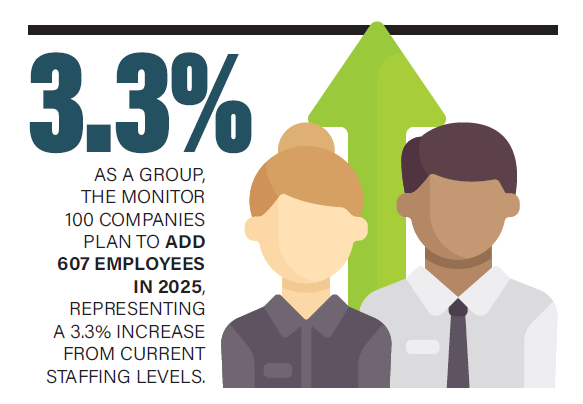
Looking ahead, the outlook is more optimistic. As a group, the Monitor 100 companies plan to add 607 employees in 2025, representing a 3.3% increase from current staffing levels. This projected rebound suggests a renewed focus on growth and capacity building, particularly as firms position themselves to capitalize on new opportunities and stabilize from recent market disruptions.
FOCUS AREAS FOR 2025: GROWTH, EFFICIENCY, AND ADAPTABILITY
As equipment finance companies look ahead to 2025, their priorities reflect a shared need to navigate economic uncertainty, sharpen operational efficiency and compete more effectively in a shifting marketplace. Leaders across all segments identified several recurring themes that will shape their strategies in the year ahead.
Technology & Operational Efficiency
Technology investment tops the agenda for many institutions. Several U.S. bank affiliates cited major system upgrades, including CRM overhauls, accounting platform migrations and end-to-end automation initiatives. One bank noted: “We plan on taking a major technological step in 2025… [to] improve efficiency and make the platform more scalable for growth.” Others highlighted the need to reduce manual processes, improve onboarding and support growth without expanding headcount.
Independents are also doubling down on modernization, implementing tools and investing in analytics platforms to improve reporting and pricing intelligence. “Improving technology companywide — everything from operating technology to online portals” was a stated priority for one independent.
Customer Experience & Relationship Management
Enhancing client engagement remains a key objective. From expanding customer and vendor portals to launching direct sales initiatives and enhancing digital self-service, companies are refining their interactions with clients. Several banks emphasized integration across business lines to deliver a more seamless client experience. Independents, meanwhile, are focusing on personalized service, with several citing tailored product offerings and improved partner experiences as priorities.
Talent, Training & Knowledge Transfer
Talent development is another area of active focus. Retirement waves, hiring delays and a highly competitive labor market have created urgency around succession planning and team readiness. “Long-standing members of the department are retiring … which will leave a knowledge void for a time,” noted one bank leader. Both banks and independents emphasized the importance of training programs, internal mentorship and retaining institutional expertise as they modernize their workforces.
Profitability, Pricing Discipline & Portfolio Performance
With interest rates expected to remain elevated, maintaining margins and managing portfolio performance are top concerns. Several firms cited the challenge of “irrational pricing” from competitors and the need for pricing discipline. “The challenge we would address is the fear of irrational pricing by competitors who prioritize building their balance sheets and banking the cost of funds. This challenge creates market instability and drives unsustainable practices, leading to long-term inefficiencies and risks for all players in the industry,” said one independent. Leaders are also tightening their focus on net interest margin, credit quality and originations discipline to sustain profitability in a competitive environment.
Growth Strategies & Market Positioning
Growth remains on the table, but it’s being pursued with more selectivity and strategic alignment. Multiple banks are targeting higher-yielding assets and refining credit parameters, while independents are focused on originating high-quality transactions and expanding their customer base. One firm shared its goal to “continue to grow organically, offering superior customer service with the best technology and user experience.” Others mentioned expanding into new verticals, building syndication networks or increasing market share through automation and capital structure optimization.
Navigating the Macroeconomic Environment
Uncertainty around interest rates, inflation and trade policy continues to weigh heavily on strategic planning. Leaders across all institution types emphasized the importance of adaptability, risk management and scenario-based planning in an evolving economic climate. As one bank put it: “Helping our clients navigate this environment while protecting the health of our portfolio will be a top priority for us.”
FORECASTS
Looking ahead to year-end 2025, Monitor 100 companies are projecting modest but positive growth across portfolios, originations and staffing. Of the 91 companies that submitted a forecast for their year-end portfolio size, 70 (77%) anticipate an increase, 7 (8%) expect a decrease, and 14 project no change. On a weighted average basis, the group forecasts a 1.1% increase in total assets, signaling a slower pace of growth compared to prior years.
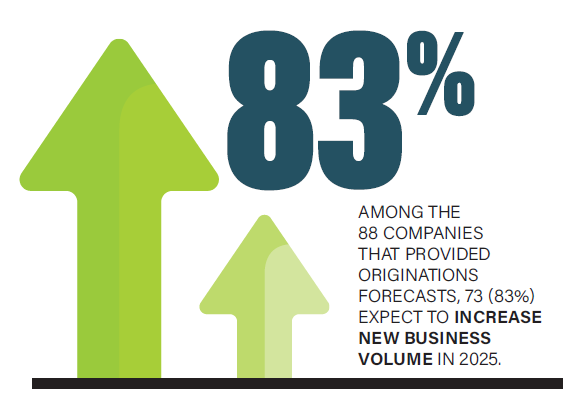
Expectations for new business volume are more bullish. Among the 88 companies that provided originations forecasts, 73 (83%) expect to increase new business volume in 2025, while six anticipate a decline and nine foresee no change. The weighted average forecast calls for a 4.7% increase in total originations — a notable jump from last year’s forecast of 2.8%, and a signal that many in the industry see room for expansion despite continued macroeconomic uncertainty.
On the staffing front, 85 companies weighed in, with 71 (84%) expecting to grow their teams in 2025. Just seven predict reductions, and seven plan to hold steady. Overall, the group forecasts a 3.3% increase in full-time headcount, suggesting a renewed focus on building internal capacity to support anticipated growth in portfolio and origination activity.
Together, these forecasts reflect a cautiously optimistic outlook. While asset growth projections have cooled, expectations for originations and staffing suggest many equipment finance leaders are preparing for a more active and expansionary year ahead.
As always, we appreciate the time and effort of the equipment finance companies that participate in our annual survey. The Monitor 100 would not be possible without the ongoing cooperation of the equipment finance community.•
Rita E. Garwood is Editor in Chief of Monitor.
1 “U.S. Economic Outlook: June 2025,” Wells Fargo Economics, June 11, 2025.
2 “Beige Book – May 2025,” Federal Reserve, June 4, 2025.
3 “The Employment Situation — May 2025,” Bureau of Labor Statistics, June 9, 2025.