

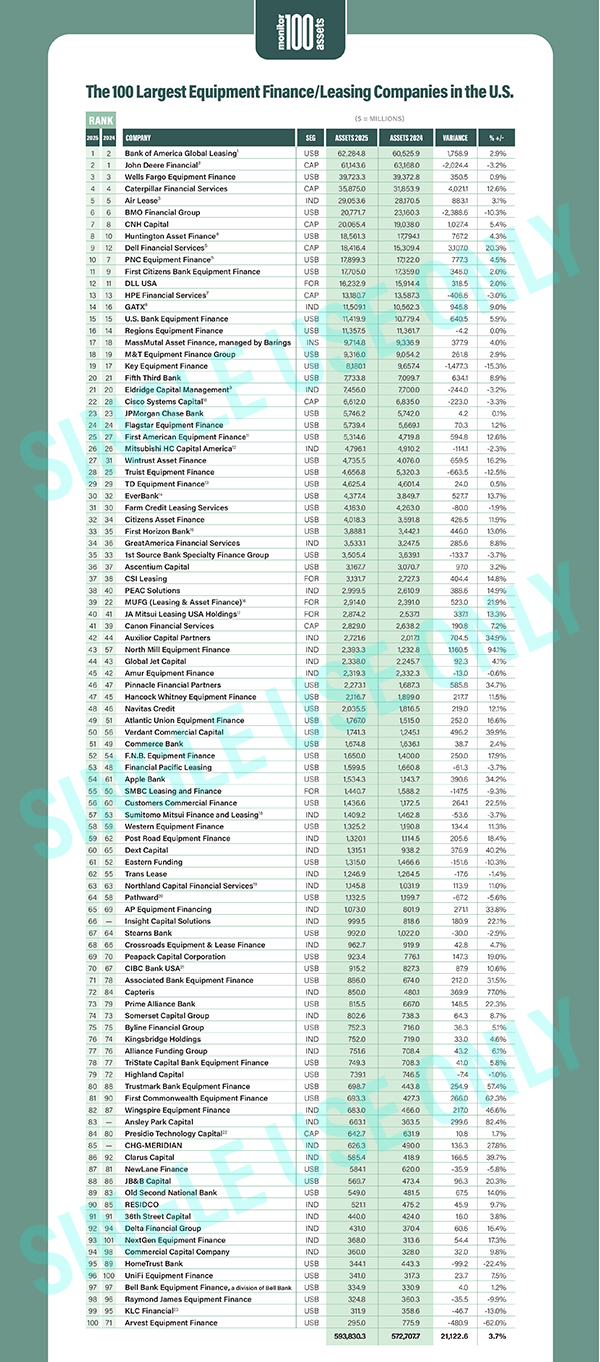
The 2026 Monitor 100 companies reported net assets of $593.8 billion, new business volume of $211.9 billion and 24,993 employees.
The group’s collective net assets grew by 3.7% in 2025, up from the previous year’s 2.0% growth rate. Seventy-five companies expanded their portfolios, adding a total of $30.1 billion in assets. Meanwhile, the net assets of 25 companies declined by a combined $9.0 billion. The result: a collective gain of nearly $21.1 billion.
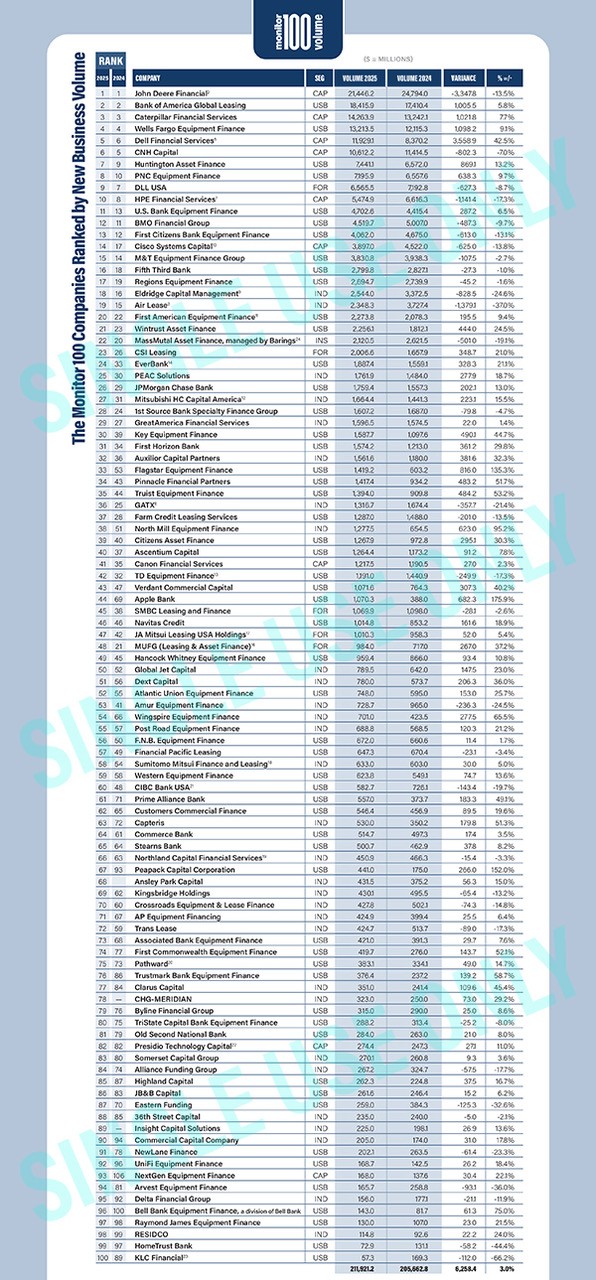
New business volume rose by 3.0% in 2025, adding a nearly $6.3 billion year-over-year increase in originations. While 34 companies reported a combined decline of $12.7 billion, this was offset by $18.9 billion in gains from the other 66, resulting in another year of modest growth despite headwinds affecting roughly a third of the group.
BANKS REBOUND ON VOLUME AS RATE RELIEF TAKES HOLD
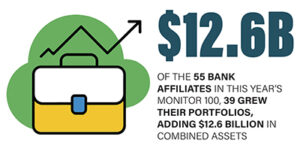
U.S. Bank Affiliates found firmer footing in 2025. Net assets rose 2.2% to $312.3 billion, while new business volume climbed 8.5% to $105.2 billion — a sharp reversal from the prior year, when banks posted slight declines. Of the 55 bank affiliates in this year’s Monitor 100, 39 grew their portfolios, adding $12.6 billion in combined assets, while 16 saw a combined $5.8 billion pullback.
Much of the anxiety that defined 2024 — banking-crisis aftershocks, staffing gaps, compliance overload — gave way to a steadier, if still uneven, operating environment. Interest rate uncertainty remained a pressure point, though several institutions noted the worst of the rate volatility had begun to settle by year-end. Tariff policy introduced a new source of unpredictability, with many banks describing front-loaded equipment purchases early in the year followed by a demand air pocket later on, complicating forecasting for 2026. Competitive margin compression persisted, and credit quality in trucking and over-the-road transportation continued to require closer scrutiny.
Looking ahead, banks are converging on a common priority: technology, and increasingly, artificial intelligence. More than a third of bank affiliates named AI adoption — from fraud detection to workflow automation to client-facing efficiency — as a top focus for 2026, a marked jump from the general technology-modernization language that dominated last year’s responses. “Technological advancements, inclusive of AI, to provide the most efficient financing solutions in support of our clients’ needs,” was how one bank summarized its priority for the year ahead. Talent and recruiting remained a live concern, but for some institutions, the tone shifted from defensive (backfilling departures) to offensive (hiring to support growth).
INDEPENDENTS GROW ASSETS BUT VOLUME SLIPS AS COMPETITION BITES
Independent equipment finance companies posted a mixed year. Net assets grew 8.5% to $86.4 billion, among the strongest growth of any segment, but new business volume slipped 1.2% to $23.7 billion — a notable reversal from 2024’s double-digit volume gains. Of the 31 independents in this year’s group, 26 expanded their portfolios, adding $7.2 billion, while just five declined by a combined $442.3 million. Volume told a more divided story: 19 companies grew originations while 11 pulled back, with the decliners’ combined drop of $3.1 billion outweighing the gainers’ combined increase of $2.8 billion.
Independents pointed to a familiar mix of pressures. Tariff-driven uncertainty was the most frequently cited challenge, with several companies describing softened demand as customers delayed purchase decisions pending clarity on trade policy. Competitive intensity remained elevated, with more than one company citing pricing pressure from an expanding field of independents chasing the same transactions. Growth itself created strain for others: firms managing rapid expansion cited the challenge of scaling staff, systems and service quality in step with new business. “While we have generated consistent volume and healthy profitability, we have not expanded our new volume as expected,” noted one independent, adding that continued growth would be necessary “to avoid stagnating or experiencing net runoff.”
For 2026, independents are focused overwhelmingly on efficiency and technology, with AI adoption and process automation the most cited priorities — echoing the theme running through the bank affiliate responses. Several firms also emphasized sales execution and productivity as a lever for growth in a market where organic demand has been harder to come by.
CAPTIVES & FOREIGN AFFILIATES HOLD STEADY AS VOLUME GROWTH BROADLY STALLS
Captives grew net assets 3.7% to $158.8 billion in 2025, with five of the segment’s eight companies expanding their portfolios by a combined $8.4 billion, while three companies pulled back by $2.7 billion. New business volume, however, slipped 1.8% to $69.3 billion — one of several signs that asset growth and origination activity decoupled across much of the industry this year. Among the captives that offered commentary, tariff uncertainty and softer equipment demand were the most-cited 2025 headwinds, with several pointing to AI and data infrastructure as a 2026 priority.
Foreign affiliates posted the strongest asset growth of any segment at 5.7%, reaching $26.6 billion, with four of five companies expanding. New business volume was essentially flat, up just 0.1% to $11.6 billion.
Taken together, the pattern across captives and foreign affiliates mirrors what played out industry-wide: portfolios continued to expand even as new origination activity lost momentum. Only bank affiliates’ volume growth outpaced asset growth in 2025 — every other segment either saw volume decline outright or grow more slowly than assets, suggesting that 2025’s gains were built more on existing portfolio performance than on fresh lending activity.
WAR IN THE MIDDLE EAST RESHAPES THE ECONOMIC BACKDROP
The macroeconomic story of the past year turned less on the tariff and rate-cut debates that shaped 2024 and more on an external shock: war between the United States, Israel and Iran beginning in late February 2026, and the resulting disruption to global oil markets through the Strait of Hormuz. The strait normally carries more than a quarter of the world’s seaborne oil trade, according to the U.S. Energy Information Administration (EIA), and the near-total halt in shipping sent Brent crude up more than 60% within a month.
By early July, prices had eased back toward pre-war levels near $68 per barrel as shipping resumed and a U.S.-Iran memorandum of understanding took hold, though the EIA cautioned a full return to pre-conflict trade patterns may not occur until 2027.
The ripple effects were significant while the disruption persisted. The Federal Reserve’s June 2026 Beige Book reported economic activity increasing at a slight-to-moderate pace in 10 of 12 districts but described inflation rising at a moderate-to-strong pace nationwide, with conflict-driven energy costs cited as the primary factor and higher-income households notably more insulated from the increases than middle- and lower-income consumers.
Fed leadership also recently changed hands. Kevin Warsh was confirmed as its 17th chair in May 2026, succeeding Jerome Powell. At his first meeting as chair on June 17, the Federal Open Market Committee voted unanimously to hold the federal funds rate at 3.50%–3.75%, where it has sat since a round of cuts in late 2025, citing solid growth alongside inflation still elevated above its 2% target. The committee’s updated projections marked a notable shift: where the median forecast pointed to a rate cut by year-end as recently as March, most officials now see rates holding steady or rising in 2026.
For equipment finance companies, the practical upshot is a rate environment that looks less like the gradual easing cycle anticipated a year ago and more like an extended, uncertain pause.
HEADCOUNT CONTRACTS AGAIN, BUT HIRING PLANS POINT TO A REBOUND
The national labor market cooled heading into summer. U.S. employers added just 57,000 jobs in June 2026, well below the revised 129,000 added in May and short of consensus expectations, while the unemployment rate held at 4.2%. The slowdown was driven in part by a drop in labor force participation, which fell to 61.5% alongside a steep decline in leisure and hospitality hiring.
The equipment finance sector’s employment picture told a similar story of contraction. Among the 96 Monitor 100 companies with comparable data in both years, full-time headcount fell 1.13% in 2025, a net decline of 32 employees. Fifty-nine companies added staff, but the gains were outweighed by cuts at 31 companies, whose combined reductions more than doubled the gains posted by those that grew. The pullback was concentrated among bank affiliates, which were down 4.1%, while foreign affiliates, independents and captives moved in the opposite direction, increasing 6.5%, 2.9% and 0.4%, respectively, continuing a divergence between segments throughout this year’s results.
FOCUS AREAS FOR 2026: EFFICIENCY, GROWTH & A NEW EMPHASIS ON AI
Technology and operational efficiency remain the dominant theme as equipment finance companies look toward 2026, but this year’s responses reveal something new: artificial intelligence has emerged as a distinct priority.
Nearly one in five companies named AI specifically as a top focus, spanning banks, independents and captives alike.

ARTIFICIAL INTELLIGENCE
While last year’s technology commentary focused on system upgrades and automation more broadly, this year’s responses named AI directly and often, citing applications ranging from fraud detection to portfolio servicing to client-facing efficiency. “Incorporate AI into our daily work rhythms to provide a more efficient and valued client experience in order to gain market share and outsized growth,” was how one bank affiliate put it. For some, AI adoption was framed explicitly as achieving growth without adding headcount — a theme that connects directly to this year’s continued staffing contraction.
TECHNOLOGY & OPERATIONAL EFFICIENCY
Beyond AI specifically, system consolidations, IT migrations and workflow automation remained common priorities across banks and independents alike. “Improvement and consolidation of technology systems to enhance process efficiency” was a stated priority for one bank affiliate, while an independent pointed to “successful implementation of key technology and process improvement initiatives” as critical to staying competitive.
GROWTH STRATEGY & MARKET POSITIONING
Growth remained a priority across segments, though responses skewed toward targeted expansion — new verticals, geographies or product lines — over broad-based volume growth. One bank affiliate pointed to “clean energy syndication capabilities” and moving “upmarket for larger opportunities” as its 2026 focus.
CUSTOMER EXPERIENCE & RELATIONSHIP MANAGEMENT
Client relationships and service quality remained a consistent priority, particularly among independents in specialized sectors. “Our customers appreciate our value-added product offering and the benefit of our industry experience,” noted one independent, adding that origination success depends on clients recognizing that value beyond financing alone.
TALENT, HIRING & RECRUITING
Talent-related priorities were less prevalent than in recent years but remained meaningful for growth-focused firms. Several companies emphasized recruiting and hiring quality as much as quantity. “Being a growth organization, it is imperative that we continue to recruit and hire top talent. You just can’t afford to make mistakes around hiring,” said one independent, describing a hiring model built around finding experienced people who fit the company’s culture.
FORECASTS: A MORE OPTIMISTIC OUTLOOK FOR YEAR-END 2026
After a solid, if uneven, 2025 — one defined by continued headcount discipline and modest but broad-based growth across most segments — Monitor 100 companies entered 2026 with notably more optimistic expectations, even as they now face a considerably more turbulent operating environment than the one they navigated last year.
Of the 88 companies that submitted a year-end portfolio forecast, 76 (86%) anticipate an increase in assets, four (5%) expect a decrease and eight project no change. On a weighted basis, the group forecasts 3.7% growth in total assets for 2026 — a meaningfully faster pace than the 2.0% actually achieved industry-wide in 2025, and a signal that this year’s modest asset gains are expected to accelerate rather than plateau.
 Expectations for new business volume are even more bullish. Among the 88 companies that provided originations forecasts, 75 (85%) expect volume to increase in 2026, five anticipate a decline and eight foresee no change. The weighted-average forecast calls for 5.7% growth in total originations, a sharp reversal from 2025, when volume growth was uneven across segments and independents’ new-business volume declined outright.
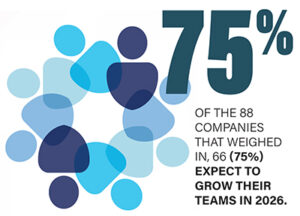
Staffing plans point to a similar rebound. Of the 88 companies that weighed in, 66 (75%) expect to grow their teams in 2026, 12 predict reductions and 10 plan to hold steady. The group forecasts a weighted 1.6% increase in full-time headcount, adding a projected 297 jobs — a modest but real reversal from 2025’s actual 1.78% decline in comparable headcount.
Together, these forecasts describe an industry carrying real momentum into a far less certain year. Monitor 100 companies are now projecting faster asset growth, a rebound in originations and renewed investment in staffing for 2026 against a considerably more volatile geopolitical and monetary backdrop.
As always, we appreciate the time and effort of the equipment finance companies that participate in our annual survey. The Monitor 100 would not be possible without the ongoing cooperation of the equipment finance community.
Rita E. Garwood is editor in chief of Monitor.