
Women across the equipment finance industry are aiming high, but survey data and first-hand insights show that systemic hurdles and shifting work models continue to test their path to leadership.
What do women in equipment finance want, and what’s standing in their way? A recent survey of the women whose profiles have appeared in Monitor’s annual Women in Equipment Finance issue sheds light on both questions, offering a snapshot of ambition, opportunity and persistent barriers in an industry still working toward full inclusion. The survey, conducted in the fall of 2025 and answered by over 100 respondents, includes women across all levels of leadership, from C-suite executives to emerging managers. Their responses offer a nuanced, at times candid, view of the evolving landscape for women in the sector.
 AMBITION IS HIGH, BUT C-SUITE GOALS VARY
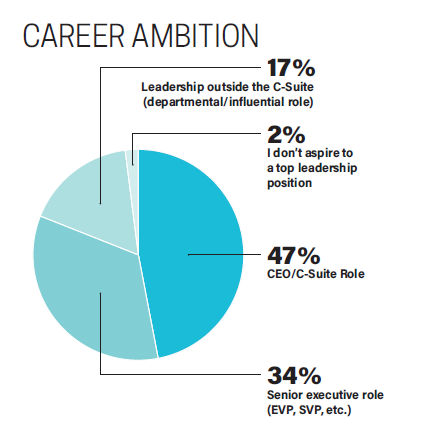
Nearly half of respondents (47%) said their long-term career goal is a CEO or C-suite position, while another 34% aim for senior executive roles. Only 2% reported no desire for top leadership. This thirst for advancement demonstrates that a deep bench of talent is ready to move up to the next level. “That first leap into leadership wasn’t just about a title, it was about believing in my potential, even when the timing wasn’t perfect and the path wasn’t clear,” says Tina Eickhoff, SVP and Head of Equipment Finance at U.S. Bank. The majority of survey respondents clearly have high ambitions. So why don’t we see more women reaching the top?
 BARRIERS STILL STANDING
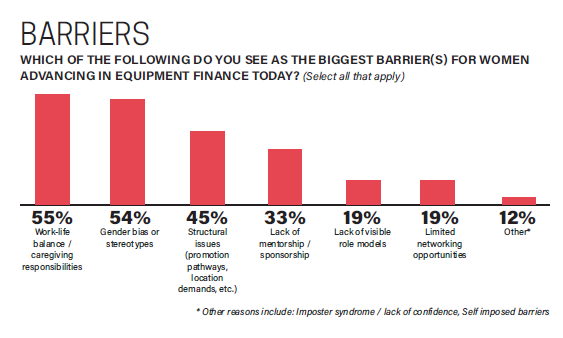
The top two barriers identified were work-life balance and caregiving responsibilities (55%) and gender bias or stereotypes (54%). Both continue to shape how, and how far, women can advance.
“There’s no clear roadmap for women, so we have to think outside the box,” says Nancy Robles, CEO of Eastern Funding. “Mentorship — especially from relatable figures — is critical.”
Interestingly, nearly one-third of respondents cited structural issues like unclear promotion paths or rigid location demands. And 45% pointed to a lack of mentorship and sponsorship, which have been known to limit advancement for women and other underrepresented groups.
Comments in the survey’s open-text field added nuance. Some respondents pointed to mindset issues or internal hesitation. One respondent said, “Women often don’t apply for jobs unless they meet all the qualifications.” In contrast, others emphasized external limitations, such as the lack of mid-level women attending industry events.
“One of the barriers women still face when pursuing leadership roles is self-doubt — often questioning whether they’re truly ready or capable,” says Iman Eddini, Chief Human Resources Officer and Member of the Executive Board, DLL.
“There’s a tendency for companies to overlook women at the mid-career level when allocating resources for growth opportunities,” another respondent noted.
“A lot of societal barriers remain stubbornly in place, like access to affordable, quality childcare, care options for aging parents, the ‘second shift’ of homelife, etc., much of which still falls to women,” says Linda Redding, Managing Director and Head of Equipment Finance, J.P. Morgan Commercial Banking. “While it would be difficult for the industry to address these things specifically, firms can recognize the needs of today’s employees and ensure that they have policies and a culture that is supportive of a good quality of life for everyone, versus something designed specifically for women.”
BALANCING FREEDOM AND VISIBILITY IN A HYBRID WORLD
The transition to hybrid and remote work has had a mixed impact on survey respondents, though largely positive. Forty-nine percent said remote/hybrid models have improved their career prospects, and another 16% reported a significant improvement.
But 32% said it had no impact at all, and a small portion (3%) felt their prospects had worsened due to remote work.
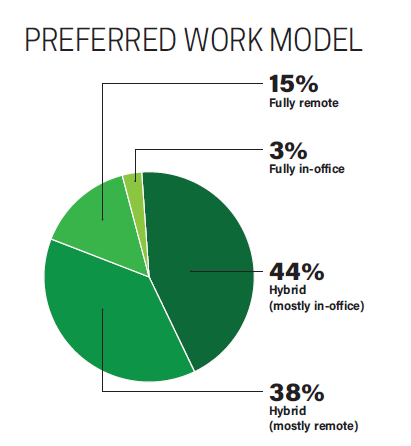
Still, preferences lean clearly in one direction: 82% prefer a hybrid model, with the majority favoring “mostly remote” arrangements. Only 3% prefer fully in-office work — a telling signal as companies increasingly push for return-to-office
mandates.
“A hybrid model certainly has benefits when it comes to flexibility,” says Amrita Patel, Head of Equipment Finance, Wells Fargo. “Whether someone is remote or hybrid, though, the qualities of leadership are the same: be present, communicate clearly and raise your hand for stretch projects.”
Robles adds a caution: “Hybrid work is a game-changer, but full remote can be isolating. Out of sight really can mean out of mind.”
A study published by the Academy of Management Annals measured the impact of remote work on the careers of women, finding that remote work can simultaneously enhance and damage a woman’s career, creating issues with boundary control and interference, enhanced and reduced job opportunities and social integration and exclusion.
WHAT DRIVES AMBITION?
When asked what motivates their career ambitions, 65% cited compensation, followed closely by a desire to mentor and lead others (61%) and personal fulfillment or passion for their work (58%).
While money matters, as it should, respondents expressed a strong drive to make an impact and to grow personally. Over half also named influence and decision-making authority as a key motivator.
This points to a generation of professionals who want more than titles — they want agency.
DEFINING LEADERSHIP
When asked to define leadership success, the top choice wasn’t achieving a title. Instead, 41% said “building and inspiring teams” defines success, followed by driving measurable business results (31%). Only 2% equated leadership with reaching the top title.
“Leadership today is increasingly defined by impact, not title,” Patel says. “The emphasis is on making a difference — regardless of where you sit on the org chart.”
Redding emphasizes the importance of knowing your “why”: “To be a successful leader, you have to know that you have the ideas, energy and desire to lead a team.”
“Leadership happened because I was driven by purpose — to help others have better experiences than I had,” Robles says.
 PRIORITIES FOR THE FUTURE
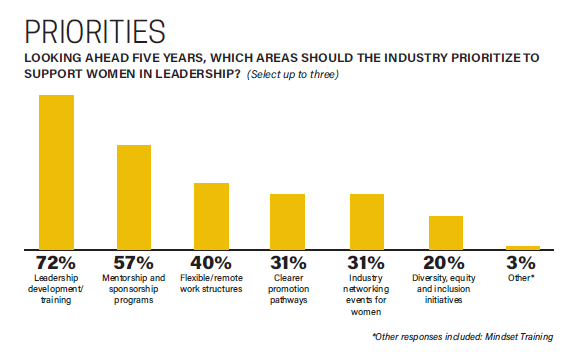
So what can the industry do to help? The survey asked women to select up to three areas the equipment finance sector should prioritize over the next five years to support women in leadership better.
The most common answers were Leadership development and training (72%), Mentorship and sponsorship programs (57%) and Flexible or remote work structures (40%).
In short, women are asking for access, visibility and opportunity. They want to be coached, challenged and championed — not sidelined or assumed to be uninterested.
Also notable: 31% want to see clearer promotion pathways, echoing earlier concerns about structural barriers. The ask is simple: transparency in how advancement happens and who gets considered.
 ABOUT THE RESPONDENTS
The respondents represent a range of tenure and roles:
• 48% have worked in the industry for more than 20 years
• 34% are in C-suite roles, with another 25% in senior executive positions
• 42% work at independent finance companies, followed by 34% at bank-affiliated firms
Geographically, responses were well distributed across the U.S., with the Midwest (34%) and Northeast (24%) making up the largest groups.
CONCLUSION: A CALL FOR INTENTIONAL PROGRESS
The survey paints a picture of a motivated, experienced and forward-looking group of women who are deeply invested in shaping the future of equipment finance. They want the industry to meet them halfway: with systems that recognize potential, remove structural bias and provide the tools to succeed.
“At the heart of every woman is resilience, creativity and determination,” says Barbara Griffith of SCL Equipment Finance, a Division of Southern California Leasing. “By honoring these strengths and giving herself room to rest as she leads, she inspires and shapes the future with grace and purpose.” •
Rita E. Garwood is Editor in Chief of Monitor.