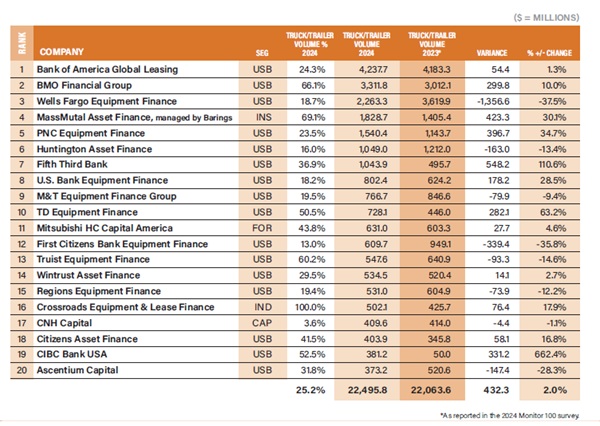
The trucks and trailers financing market remains steady, with demand driven by replacement cycles, regulatory compliance and freight volume, according to Anthony Sasso, head of TD Equipment Finance. “Customers remain focused on cost control, but financing remains critical for fleet refreshes,” Sasso notes.
In the used truck segment, ACT Research reported mixed signals in August. Same dealer Class 8 used truck retail sales volumes climbed 14% month over month, but pricing retreated. The preliminary average retail price for Class 8 trucks fell 5% from July to $57,600, counter to expectations for an 8% gain. “Values also sank in the other channels,” said Steve Tam, vice president at ACT Research, pointing to auction prices down 6% and wholesale prices off 11% month over month. Combined, overall average sales prices slipped 5%, highlighting lingering pricing pressure despite improved unit movement.
On the trailer side, ACT Research reported preliminary net orders of 9,000 units in August, a 3% increase from July and 17% above last year’s level. When seasonally adjusted, August’s tally rose to 11,500 units. Year-to-date, net trailer orders total 109,800, up 23% from the same period in 2024. However, caution
persists. “Concerns about moderating economic activity, ongoing weak for-hire carrier profitability, and ambiguous policy shifts remain as challenges to stronger trailer demand,” said Jennifer McNealy, ACT’s director of CV Market Research & Publications.
Cancellation rates eased to 1.9% of backlog in August, down from 4.2% in June, providing some stability. Still, ACT maintains a subdued outlook for 2025, citing insufficient momentum to drive a robust recovery.
Taken together, the trucks and trailers market is balancing steady demand drivers with continued pricing and profitability pressures. Financing will remain a key lever as fleets refresh equipment, manage compliance and position for longer-term efficiency gains.
What can we expect over the next six to 12 months? “Watch for continued investment in fuel-efficient and lower-emission vehicles, ongoing supply chain normalization and potential impacts from interest rate changes,” Sasso says. “These factors will shape both demand and financing structures.” •
View Interactive Charts on Suite by Monitor