The U.S. construction sector enters the second half of 2026 on a fundamentally healthy but increasingly selective footing, with growth concentrated in a narrower set of high-demand segments even as overall spending sits below year-ago levels.
Total U.S. construction spending held at a seasonally adjusted annual rate of $2.21 trillion in May, up 0.1% from April and down 1.5% year over year, according to the U.S. Census Bureau. Year-to-date spending was 2.7% below the same period in 2025, with manufacturing down nearly 22% even as highway spending posted double-digit gains. Dodge Construction Network’s Momentum Index slipped 1.9% in June to 271.7, though it remains up 21.8% year over year, as data center planning moderated while activity broadened into offices, warehouses, retail and hotels.
Associated Builders and Contractors reported that its Construction Backlog Indicator eased to 8.8 months in June, down 0.3 months from May but above every reading between September 2023 and April 2026. “This strength is the result of continued booming data center construction,” Anirban Basu, ABC chief economist, said. Turner Construction’s Q1/26 Building Cost Index rose to 1,530, up 1.32% quarter over quarter and 4.87% year over year, while the AIA/Deltek Architecture Billings Index climbed to 47.3 in June, still below the 50-point growth threshold amid a 41-month stretch in which a majority of firms have not reported billings growth.
FMI’s Q2/26 outlook calls for total U.S. construction spending to hold roughly flat at just under $2.2 trillion for the year, following a 1.4% decline in 2025, a year FMI describes as a “sector-specific recession,” with data centers and power carrying the market while residential remains the primary drag.
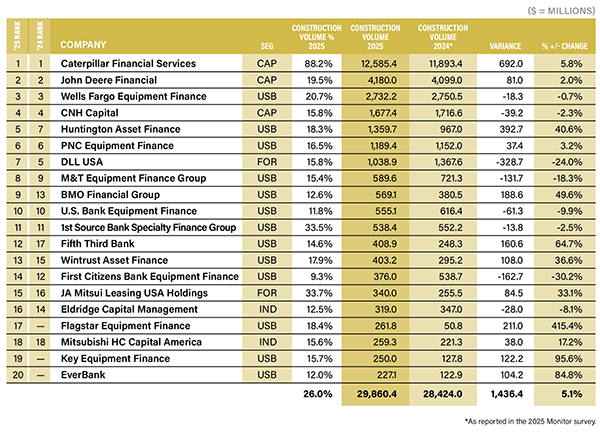
Market leaders say fundamentals remain sound even as capital discipline tightens. Flagstar Equipment Finance described the market as “active and fundamentally healthy, although customers are making capital investment decisions with greater discipline than they did several years ago.” 1st Source Bank cited “continued investment in infrastructure, LNG projects, AI-related development and data centers” as creating demand for heavy equipment and transportation assets, adding that a key question ahead is “whether demand remains elevated or begins to normalize.”