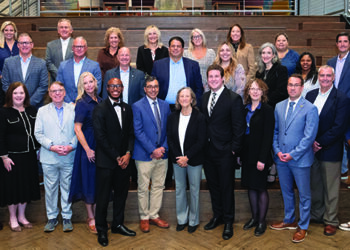

The equipment finance industry is at a critical juncture. Rapid advances in technology, changing customer expectations and a generational shift in the workforce are forcing companies to rethink how they manage credit risk, structure operations and develop future leaders.
To explore where the industry is heading, Monitor asked this year’s Top Women in Equipment Finance two questions: What is the biggest challenge facing women in equipment finance today, and what trend or shift will have the greatest impact on the industry in the next few years?
Their responses point to two imperatives. First, closing the senior-leadership gap will require moving beyond traditional mentorship to active sponsorship. Second, while artificial intelligence (AI) and automation reshape every stage of the deal lifecycle, many respondents say human judgment, domain expertise and relationships will remain the industry’s competitive advantage.
The Leadership Pipeline: From Mentorship to Sponsorship
This year, Monitor’s top women say women’s presence in entry-level and operational roles has improved, but a bottleneck remains higher up. Kayla Perlinger, senior vice president of syndications and risk at AP Equipment Financing, says women’s representation “drops significantly beyond mid-level management.” Others say women struggle to move from back-office management into revenue-generating, customer-facing and profit-and-loss roles.
Broader research points the same way. The “Women in the Workplace 2025” report from McKinsey & Company and LeanIn.Org found that for every 100 men promoted from entry level to manager, 93 women were, and that women hold 29% of C-suite roles.1 It also found that 31% of entry- level women have a sponsor, compared with 45% of entry-level men.1 A 2010 Harvard Business Review article by Herminia Ibarra, Nancy M. Carter and Christine Silva concluded that high-potential women are “overmentored and undersponsored relative to their male peers.”2
Many of this year’s top women in equipment finance say mentorship alone is no longer enough.
“The biggest challenge is still uneven access to sponsorship, not mentorship,” Marcela Sofía Cevallos, engagement manager at Kin Analytics, says. “Someone actually putting your name forward, vouching for you in a room you are not in yet… My advice to the industry is simple: If a door opens for you, open one for someone else. That’s how this stops being the exception and starts being how the industry works.”
“Move beyond mentorship to sponsorship. Mentors give advice. Sponsors create opportunities,” Rebecca Masserini-Cooper, vice president of credit operations at NewLane Finance, says. “The industry should encourage senior leaders to actively advocate for talented women by putting them forward for stretch assignments, customer-facing opportunities, speaking engagements and leadership roles.”
Lindsay Bohon, vice president of corporate sales operations at GreatAmerica, says too few women “are given early opportunities to lead revenue-generating roles or own meaningful P&L responsibility.” Bohon says the industry can accelerate progress by “intentionally placing talented women in high-visibility assignments where they can build experience, demonstrate results and develop leadership skills.”
“Mentorship is important, but sponsorship is what helps talented women move into rooms where decisions are made,” Karyn Bendure, executive vice president of portfolio management at Summit Funding Group, says. “The industry can help address this by intentionally identifying, developing and advocating for women leaders, not only when roles open, but throughout their careers.”
Jana Ahlers, senior manager of account management and leasing at Farm Credit Leasing, says the industry needs “a conscious effort” to ensure women are included in committees, boards and succession planning. Shari Williams, chief risk officer at Elevex Capital, calls for “meaningful sponsorship opportunities where senior leaders actively advocate for and develop high-potential women.” Eva Kellershof, vice president of sales for North America and Europe at NETSOL Technologies, puts it in four words: “sponsor, don’t just mentor.”
The Readiness Double Standard and the Confidence Gap
Another recurring barrier is the expectation that women must prove they are fully ready before stepping into bigger roles, while others are given the chance and allowed to grow into them.
“One of the biggest challenges is that women are often expected to prove they are fully ready before receiving an opportunity, while others are given the opportunity and allowed to grow into it,” Cathryn Massinburge, executive vice president of talent and performance at Nexseer Capital, says. “The industry needs to move beyond mentorship alone and create more active sponsorship, transparent advancement paths and intentional access to business-critical assignments. Advice is valuable, but advocacy changes careers.”
Ann Brodette, senior vice president and general manager of industrial equipment finance at Mitsubishi HC Capital America, says the solution requires action on both sides. “The biggest challenge is not capability; it’s confidence and visibility,” Brodette says. “Women often wait until they feel fully qualified before pursuing new opportunities, while others may be more willing to take a chance. My advice is for companies to actively sponsor high-potential women and for women themselves to raise their hands for stretch assignments.”
Tracey Elfering, CLFP, documentation and titling manager at Oakmont Capital Services, says credibility comes from a willingness to learn, not from having every answer. “It comes from being willing to learn, being authentic enough to say, ‘I’m not sure,’ and having the confidence and determination to find the answer,” Elfering says. “When we help women build that confidence, everyone benefits.”
Roopa Jayaraman, chief technology officer at Odessa, urges women to take on harder assignments: “Our careers are built on experience capital, and that capital compounds when you say yes to the harder brief, the unfamiliar lane, the stretch role. Growth and comfort don’t co-exist, so refuse to stay in that fixed lane… Range is its own kind of depth.”
Darcey Fuller, director of transaction management at Sany Capital USA, says women have begun to win seats at the table but now need authority once they are there. “We have begun to figure out how to get into the room; now we need to figure out how to be valued and considered as equals in those rooms where decisions are being made without conforming or sacrificing who we are,” Fuller says. “Do not simply seek to make improvements in mentorship; opt instead for sponsorship, giving women the authority to head up projects and have decision making power.”
Rosie Curiel, vice president of credit at First Financial Equipment Leasing, says confidence and decisiveness “are not always viewed the same way when demonstrated by women.” “Women should be able to challenge assumptions, make difficult decisions and lead authentically without feeling pressure to soften their voices,” Curiel says. “The industry can support this by recognizing diverse leadership styles and evaluating leaders based on their judgment, performance and overall impact.”
Sera Oliver, senior director of capital markets at Flagstar Equipment Finance, and Sara Snyder, senior vice president of operations at First American Equipment Finance, say women need both opportunities and the confidence to use their voices. Jill Fleck, co-founder and vice president of administration at Channel, says it has been encouraging to see more women step into leadership roles and support one another. Carol Schafer, vice president and business development officer at Wintrust Specialty Finance, says the challenge is “the opportunity to be included in the conversation and opportunity for growth without feeling that someone is doing you a favor.”
Pipeline Creation: Equipment Finance as an Intentional Career Choice
Several respondents noted that few people plan a career in equipment finance; most stumble into it, usually through someone they know.
Kelli Nienaber, senior vice president of industry advancement at the Equipment Leasing and Finance Association and executive director of the Equipment Leasing & Finance Foundation, calls the field a “discovery industry”: “Almost nobody grows up planning a career in equipment finance. We’re a discovery industry, which means the people who find us tend to find us through someone they already know. That’s the challenge. When entry depends on personal networks, the industry keeps replicating the networks it already has, and women are still underrepresented in them… Recommend her for the panel. Nominate her for the committee. Hand her the client relationship.”
Shannon Martin, product manager at LTi Technology Solutions, offers a concrete solution: “Awareness is the biggest hurdle. Most women — most people, honestly — end up in equipment finance by accident,” she says. “My advice: partner with universities and young professional groups to introduce this industry as a real, intentional career choice, not just a lucky landing spot.”
Lori Frasier, founder and CEO of BrightPath Workforce Strategies, says the talent pool and technology are changing at the same time. “The most consequential shift won’t be AI or workforce demographics in isolation — it will be their convergence,” Frasier says. “We’re experiencing rapid technological change at the same time the available talent pool is shifting dramatically in composition, expectations and relationship to work. The winners won’t simply adopt new technology or recruit new talent. They’ll rethink the workplace and leadership practices required to get the best from both.” Schafer also points to the emergence of AI “together with a changing demographic of new emerging talent.”
Melissa Becker, executive business officer at Stearns Bank, and Michelle Grondin, manager of strategic partner development at Financial Partners Group, believe women should be exposed to cross-functional projects and quota-carrying sales roles. Rebecca Elli, general counsel at Navistar Financial, and Erin Brown, divisional assistant vice president of marketing at Great American Insurance Group’s Specialty Equipment division, agree that access to high-impact projects and a seat at the table help women advance.
The Technological Horizon: Balancing AI With Human Judgment
When asked what will reshape the industry, most respondents point to AI and automation. “AI is already changing equipment finance, and I think its impact will only grow,” Susan Debro, vice president of contract management at Auxilior, says. Debro says AI will be used more in credit decisions, fraud detection and document review. Many respondents paired that view with a caution: Technology can handle volume and routine tasks, but human experience remains the differentiator.
Jayaraman says the gap companies must bridge is between potential and practice: “Artificial intelligence will reshape how this industry operates, but the real shift won’t be about the technology itself — it will be about conviction and practice. Most companies will not fail at AI pilots; they will fail in the gap between potential and practice, between experimentation and the operating model… In the end, AI readiness is human readiness.”
Cevallos says the human component “isn’t disappearing; it’s becoming the differentiator.” “AI is turning the technology itself into a commodity; anyone can build something that scores well on paper. What’s becoming more valuable is the judgment behind it: the underwriter who knows why an exception makes sense, the credit manager who catches what the pattern misses… The winners in equipment finance over the next few years will be the ones who use AI to sharpen human decision-making, not replace it.”
Shelly Tauer, head of equipment finance product management and strategic initiatives at U.S. Bank, cautions that having the most AI tools will not guarantee success. “While AI is generating a lot of attention right now, I don’t think the long-term winners will necessarily be the organizations with the most AI tools,” Tauer says. “The leaders will be the companies that connect their data, processes, platforms and people in a way that creates a seamless experience for clients, employees and partners.”
The Training Dilemma: How AI Affects Talent Development
Several respondents agreed that automation is changing how employees learn. As AI takes over entry-level tasks, companies face a potential gap in developing future decision-makers.
“Historically, we trained people the long way. You spent a few years doing the repetitive work, and somewhere in that repetition you absorbed judgment about credit, risk and customers. AI is taking on some of that work, which is good for efficiency and genuinely hard for talent development,” Nienaber says. “We will need new ways to help people build that judgment when the repetition that used to teach it is gone. That’s why workforce strategy and technology strategy can’t be separate conversations.”
Sarah Walter, manager at ECS Financial Services, warns that institutional knowledge is leaving as senior experts retire. “Lease accounting keeps getting more demanding while portfolios get more complex,” Walter says. “At the same time, a generation that built this industry is retiring, and much of what they know was never written down: when a structure will create problems at year-end, which modifications quietly change the accounting, how to spot a portfolio number that simply doesn’t look right. That kind of judgment is not something you can put in a job posting. You build it on purpose, by pairing experienced staff with newer staff and trusting people with real work early.”
Catherine Podlesny, vice president of human resources at PEAC Solutions, says employees will need room to learn, ask questions and understand where their experience and judgment matter most as familiar tasks evolve. She sees an opportunity for people to spend more time on work that benefits from human attention, such as understanding a customer’s needs or helping a colleague succeed.
Kristina Matkowsky, senior vice president of customer operations at North Mill Equipment Finance, says “simply implementing new technology is not transformation.” The real opportunity, Matkowsky says, is “using technology as a catalyst to rethink how work gets done,” including by questioning unnecessary handoffs and complexity.
Melana Ferguson, director of operations for equipment finance at Trinity Capital, says growth-stage companies working on technology’s next frontiers — AI, quantum computing, power, aerospace and defense — will have the greatest impact on the industry. Finance companies equipped to underwrite and service them, she says, “will be at the forefront of it all.”
Relationships, Balance and New Operating Models
Many respondents say despite rapid digital change, equipment finance remains relationship-
driven. “I believe the more we automate, the more valuable the human relationship becomes,” Tiffany Thornley, regional manager of business development at Northpoint Commercial Finance, says.
Shivi Sharma, co-founder and president at Kaaj, says AI will help make new structures such as usage-based leasing and equipment-as-a-service (EaaS) practical. “As businesses prioritize flexibility, preserve capital and adapt to changing operating needs, demand will grow for usage-based payments, equipment-as-a-service and financing that combines equipment with software, maintenance and upgrades… The companies that adapt successfully will evolve from transaction providers into long-term partners in their customers’ operations and growth.” Sharma also says the industry must ensure women are “included in the rooms where industry policy, technology investments and future operating models are being shaped.”
Cindy Trenerry, regional sales officer at 1st Source Bank, warns against over-reliance on algorithms. “While AI can improve efficiency and streamline credit decisioning, there is a risk that increased reliance on automated processes could make it harder for companies and borrowers to tell their full story,” Trenerry says. “Some businesses do not fit neatly into a model or algorithm, and their strengths are often best understood through experience, relationships and thoughtful evaluation.”
Mel Vinson, CLFP, vice president of academies and development at the Certified Lease & Finance Professional Foundation, focuses on community. “Equipment finance has always been a relationship driven business. While innovation will continue to make our industry more efficient and transform the way we work, it is the trust and meaningful relationships we build that will remain at the heart of what we do,” Vinson says. “If we can pair innovation with a strong commitment to human connection, I believe we can build an industry that is not only more efficient, but more collaborative and inclusive for years to come.”
Winnie Wang, legal director at DLL, frames AI as an opportunity. “Instead of fearing what AI can replace, we should shift our mindset to explore what could be the new normal in our daily responsibilities,” Wang says. On the challenge of balancing career and family, she offers this advice: “Take time to ask, ‘What do I need right now to fill my own cup?’ When we consistently put our own needs last, burnout becomes inevitable.”
Julie Alexander, collateral operations manager at Commercial Capital Company; Sonya Morlock-Ryals, managing director and head of credit and risk at Gordon Brothers Commercial Equipment Finance; and Emily Zwach, president at Synergy, also name work-life balance as a leading challenge.
Catherine Lee, assistant vice president of commercial marketing at EverBank, and Sharon McGarvey, project manager at Alfa Systems, say technology should free people to focus on higher-value work and give them better information, not replace human judgment.
Aimee McChurch, president of the Transportation Division at American Financial Partners, believes the industry is largely a meritocracy, though she notes that transportation finance still has fewer women in leadership than other segments. Kristen Van Wie, senior sales support at MMP Capital, advises women to seek out organizations that reward merit. Liz Rinaldi, senior vice president at Rinaldi Advisory Services, says reliable portfolio performance data will increasingly determine which organizations can secure capital. Jennifer Noah, managing director, energy, at Verdant Commercial Capital, calls for more women in front of clients and more workplace flexibility.
Charting the Next Chapter
The responses offer a clear roadmap. Respondents believe progress depends on moving from passive career guidance to active sponsorship and targeted opportunities in revenue-generating roles. And as technology advances, they say, tools, algorithms and automated models are only as effective as the human judgment, governance and trust behind them. •
1Krivkovich, Alexis, et al., “Women in the Workplace 2025,” McKinsey & Company, Dec. 9, 2025.
2Ibarra, Herminia, et al., “Why Men Still Get More Promotions Than Women,” Harvard Business Review, Sept. 2010.
Violet Synnestvedt is an assistant editor of Monitor.