

What Impressionist art teaches us about AI-native organizational design.
Did you read about the artist who got rich using AI to create impressionist art? Me neither, but I tried it. I used Gemini to add an impressionist-style portrait of myself on a park bench into one of my favorites, Georges Seurat’s pointillist masterpiece, A Sunday Afternoon on the Island of La Grande Jatte.
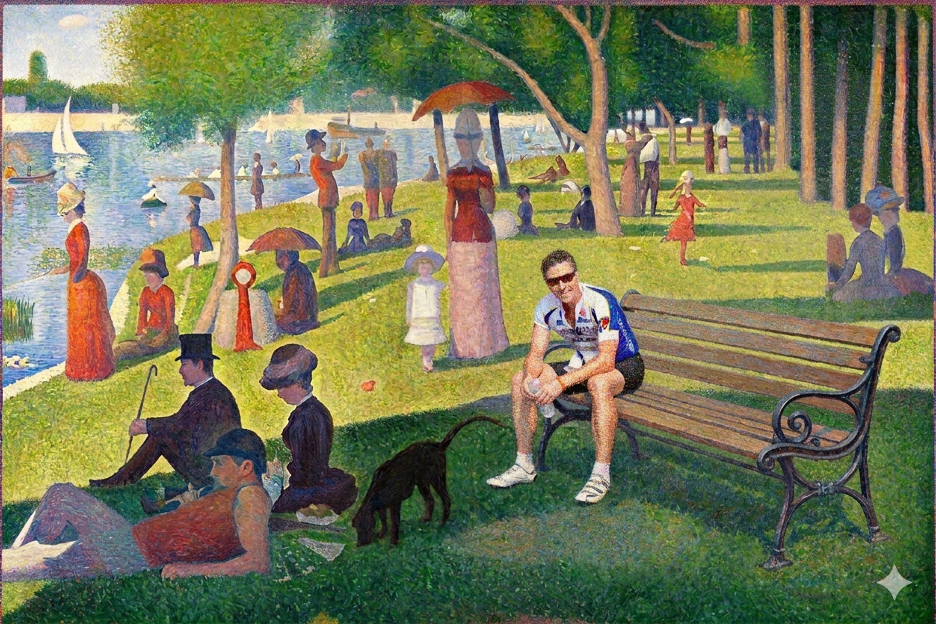
The result was novel and fun. The photographer who took the original photo rolled her eyes at the effort; however, she also expressed wonder at the seamless synthesis of historical art and a modern photograph. I don’t expect this work, or any AI-synthesized impressionist art, to ever have much financial value. Not because the AI generated art isn’t pleasing, but because the value of art is strongly dependent upon whose hands created it. The exercise clarifies perhaps the most important question in AI deployment today: what is the value of handmade in an age where a new technology can create indistinguishable replicas, extensions or substitutes of human generated artifacts like art, writing, photography and business decisions essentially for free?
Creating Value with a Reverse Turing Test Promise
Handmade is a proxy for human judgement which continues to be the gold standard of value for AI developers. The Turing Test – the ability for a machine to prevent a human evaluator from identifying its work versus a human’s – has been the industry benchmark since the 1950’s. Ironically, now that AI routinely passes the test providing content that is indistinguishable from human generated content, testing has reversed course and we are now trying to prove that something is not Ai generated, i.e., is handmade.
Premium publishers, in an effort to protect margins, are increasingly mandating entirely human-generated prose. In response, writers are deliberately altering their style to pass a ‘Reverse Turing Test.’ They actively avoid signature AI tells such as em-dashes, monotonous staccato cadences and overly dramatic affirmations. Some even introduce intentional grammatical imperfections exploiting the irony that advanced AI rarely makes basic typographical errors.
AI developers have traditionally focused on passing the Turing Test but now some human creators are passing the Reverse Turing Test to compete.
While the publishers’ preference for human composition seems sentimental rather than measured at this point, it reflects a commercial truth: provenance, an unquestionable proof of authorship, commands a financial premium. Historically, the provenance premium for human creations has been huge. A recent valuation of Seurat’s original “A Sunday Afternoon on the Island of La Grande Jatte” neared $650 million. Masterworks by Monet, Van Gogh and Munch command high nine-figure sums because the value of handmade impressionist art is not only high, but it also supports sound investment strategies for those who can afford to participate.
As corporate leaders deploy AI into traditionally manual enterprise workflows, they must study the implications of this handmade premium. Passing the Turing Test is not a guarantee of AI success. The value of handmade is real and human preferences are more complicated and nuanced than simple real time comparisons. Like Impressionist art connoisseurs, customers and partners will prefer a brand that promises not to use AI for decisions and actions that matter to the relationship. They will reward handmade.
Automating Smart and Growing Value with the Human Touch
Business leaders deploying AI today must ask the questions: “Where will handmade have greater value over time than AI generated communications, decisions, and process efficiency?” The goal is to improve competitive positioning with AI across the business and its workflows, but customers, vendors and funders are human and will have both preferences and expectations like the publishers. They will highly value handmade work in some situations. If this value is not considered, blanket technical deployments of AI will affect relationships and could decrease both the success and value of the business.
The reality is that for decision domains that exhibit high regularity and have sufficient historical examples, AI can learn the decision policies of the organization and reproduce those decision policies at the same and often better statistical accuracy as human experts. Properly trained AI can pass the Turing Test across the entire workflow, but that does not mean AI is the right choice for all decisions. A simple Turing Test approach fails to account for the fact that counterparties may assign more value to handmade decisions and appropriately reward the enterprise for this insight.
Can and Will: Customer Convenience First
AI already excels at the front-end and process-driven steps: application intake, document generation, UCC filing tracking, payment processing, covenant monitoring, maturity alerts, depreciation schedules, routine invoicing. These are pure process tasks where one system often interacts with a counterpart machine rather than humans. Mistakes here are annoying but easy to identify, correctable and the sheer task volume makes automation a no-brainer.
AI is capable of making all of the decisions in a typical equipment finance workflow.
Tasks that customers, vendors or funding partners rate highly when rapidly performed accurately, consistently and conveniently are prime targets for AI automation and augmentation. These are also tasks and decisions that have no or little handmade premium. Convenience with accuracy is the primary requirement.
No borrower, broker or regulator cares whether a human or an algorithm generated the UCC filing, calculated the depreciation schedule or sent the payment reminder. Indeed, in some cases they trust software and AI to be more reliable, consistent and accurate than humans. The outputs have no emotional or relational content. Applying the painting analogy here would be like insisting that a human mix and package the paints when the client only cares about the artist and his or her finished work.
Could but Don’t: The Promise Becomes the “Handmade” Premium
Brand is the company’s promise and keeping promises builds brand value. Decisions and communications where customers and partners have expectations of the enterprise and value knowing who authored a decision or communication have premium value. These are the tasks where even if AI can perform as accurately, i.e., pass the Turing Test, handmade has more value.
Underwriting Valuable Exceptions
When a broker or vendor brings a difficult deal and it is approved, that approval delivers an important brand message: We had an expert who understands your niche, your asset’s lifecycle value, and your credit narrative personally evaluate this risk and say “Yes.” That handmade decision demonstrates craft judgment and excellence.
The exceptions are the deals that make independent lessors money because they are the ones that don’t fit the usual A-credit patterns of others. They are the story credits with “unique” parameters. The borrower who looks bad on paper but whose equipment is highly liquid, the industry niche where the team has hard-won first-hand knowledge that the training datasets don’t capture. An AI model can learn if trained on exceptions but will not reason from first principles about a deal it has never seen. A seasoned underwriter does and delivers premium value via both the deals approved and the relationships maintained with brokers and vendors.
When approvals come from an AI model, the broker/vendor will know the AI approved the deal because it pattern-matched or made it through a checklist, not because someone took the time to understand the story. Over time, brokers will stop bringing the interesting deals because they won’t trust that a model will see what a human would. The value of handmade decisions exceeds even the high value financial returns because over time the broker/vendors, borrowers and the enterprise itself will return to the brand promise of craft excellence.
The right hands create value that grows
Seurat, Monet, and Renoir were not average painters. Their work had value when first done and it increased over time as their exceptionalism became more apparent. When a longtime vendor or broker partner brings a deal and a senior person at the company personally approves it that act is partly a business decision and partly a reaffirmation of the relationship. “We looked at this because you brought it to us” has value that an automated approval does not carry.
Beware: when the brand is built on human judgment but then runs AI models behind the scenes, brokers, vendors, and borrowers will figure this out. When these tasks are automated counterparties can perceive it as inauthentic, undermining relationships. The trust damage will be worse than if the brand marketing had been transparent about automation from the start. The handmade premium only holds if the provenance is real.
More Productive Artists
Independent lessors are, by definition, artists. They each are practitioners of the craft with their own individualized style just like the impressionists. Seurat invented Pointillism; it is what attracted me to him. He painted with a brush in the 1880’s the way big LCD TVs create digital images today. I found his work prescient.
The big captives, banks and specialty platforms are very good at selling consistent, reliable, efficient and cost-effective “prints”. They will use AI broadly across their workflows to drive their strategies leveraging lower costs of capital protected by operational efficiency to reproduce multitudes of good deals. But smaller, independent firms compete by operating at the edges, by innovating, by selling originals. They can use AI to increase throughput and reduce error on process, but they use human judgment on the exceptions when the counterparties are people with relationships to protect to grow the business. Competitive differentiation and enterprise value come from doing the deals the big firms won’t do by leveraging human judgment on the right exceptions and building relationships of trust that last. Their art doesn’t scale by replication; it scales with deal selectivity and talent within the organization.
We are past the Turing Test and the question “Which decisions can AI make?” The answer is “All of them.” But “all of them” is not the right deployment strategy. The right deployment question is “Which decisions are part of our brand promise?” Those will be the ones with a handmade premium that will mature and grow brand value over time just like an original impressionist painting.
AI may be inevitable, but do not underestimate the value of handmade.