

Lessors face a dilemma, as many customers want the financial reporting and income tax benefits of synthetic and true/fair market value (FMV) operating leases. The problem is that lessor accounting for operating leases negatively affects the “efficiency ratio” of the lessor, an important financial measure for banks and finance companies. Studies suggest a statistically significant relationship between efficiency ratios and stock prices. I worked for bank lessors for 30 years, and the parent bank CFO did not want us to originate operating leases, but they wanted the profitability of operating leases, so we had to manage our operating lease portfolio by using residual value insurance where prudent (considering the premium’s cost and its impact on portfolio rates of return). Buying residual value insurance can change the classification of an operating lease to a finance lease, which has a positive impact on the efficiency ratio.
The Banking/Finance Industry Efficiency Ratio Explained
An efficiency ratio measures how effectively a bank/finance company uses its assets and manages operating expenses to generate revenue. It gives investors and analysts critical insights into a business’s operational productivity, cost control, and overall financial health, and it can directly affect analysts’ ratings for lending and investing. It often correlates with increased profitability. It is best to compare efficiency ratios with those of industry peers to benchmark performance, rather than relying solely on a single company’s ratio. In the financial and banking sectors, including lessors, the “efficiency ratio” has a highly specific meaning.
General Rule: Lower is Better
A ratio of 50% or below is generally considered optimal, meaning the bank is spending less than 50 cents to earn every dollar.
- Formula: Non-Interest Expenses / Total Revenue (Net Interest Income + Non-Interest Income)
- Since a bank’s operating expenses are in the numerator and its revenue is in the denominator, a lower efficiency ratio means that a bank is operating better.
The Problem with Operating Leases
For direct finance leases, the lease revenue added to the denominator is the net lease revenue (lease revenue less interest cost to carry the lease), and no expenses are added to the numerator.
For operating leases, the revenue added to the denominator is the net lease revenue (rent revenue less the interest cost to carry the lease), and the depreciation of the leased asset is added to the numerator. The problem is that the operating lease asset is treated like any other fixed asset (just like a computer, ATM or even a building), and its depreciation is treated as a business expense, the same as the depreciation of any other fixed asset.
Another issue with operating leases is that the income pattern is back-ended, versus finance leases that have a constant rate of return. Changing the lease classification by purchasing residual insurance solves this problem, but it is too complex to cover in this article.
How to Deal with the Problem
Lessors can change the lease classification of an operating lease by working on the present value (PV) classification test. If the present value of lease payments, as defined, is 90% or more of the fair value (cost) of the leased asset, it means the lease is a finance lease for the lessor. For classification purposes, any residual guarantee (including residual insurance) is treated as a lease payment. Therefore, if enough residual insurance is purchased at lease commencement to bring the present value to 90% of the asset cost, the classification changes.
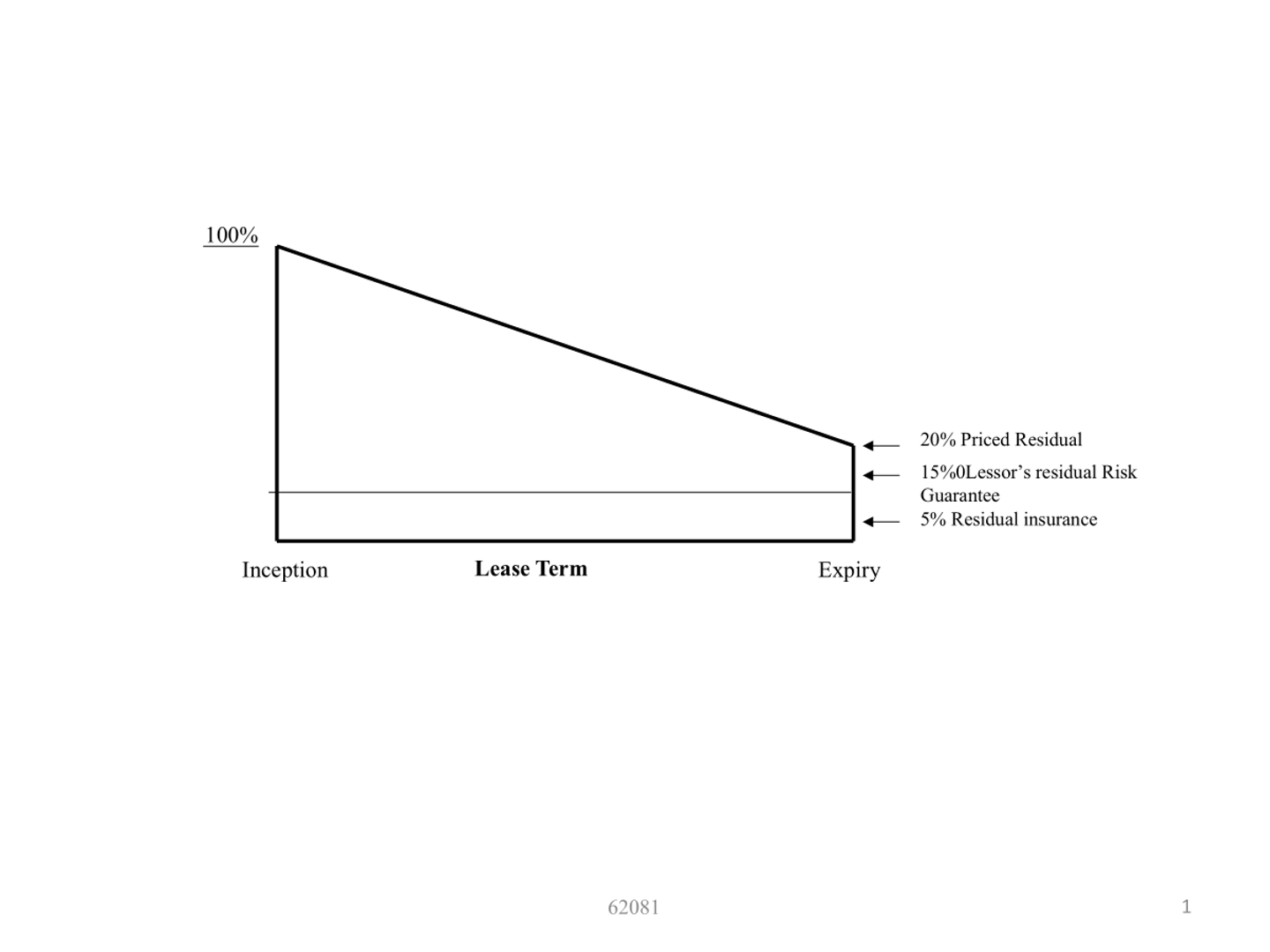
The typical residual insurance used to change lease classification is “last-loss” insurance. I have heard it described as “FASB insurance” as its purpose is to change lease classification and not insure any meaningful residual risk. Last-loss insurance means the insured amount is the amount just above zero asset value. As an example, assume a lessor is assuming a 20% residual in its pricing and buys 5% residual insurance (assuming the 5% insured amount, when included in the 90% PV classification test, causes the PV of payments to equal 90% of the asset cost). In the example, the lessor bears the first losses (15%), and the insurance covers the last 5% of losses. See the diagram below:
Conclusion
Efficiency ratio and return on assets (ROA) are two important measures that impact the share price of a lessor/financial institution. Consider the economics of a residual insurance purchase to change lease classification and improve the measures. The premium is low (it varies based on facts). In my experience, the easy choices are synthetic leases and split-TRAC leases where the PV of payments is very close to 89.9%. Other traditional FMV leases with a lower PV of payments need more analysis.
Bill Bosco is the CEO of Leasing 101, a lease training and consulting company. Bill has 50 years of experience in the leasing industry. His areas of expertise are accounting, tax, financial analysis, structuring and training. He frequently writes and speaks on leasing topics. He has received awards from ELFA and Monitor magazine, including induction into the ELFA Leasing Hall of Fame. He can be reached at wbleasing101@aol.com. Check out his website at leasing-101.net.