



The 2026 Alta Group survey reveals a landscape of cautious optimism as construction equipment holds its top spot for the 12th consecutive year, while sectors like rail and aircraft show significant recovery against a backdrop of evolving regulations and shifting interest rates.
In January 2026, The Alta Group, LLC (“Alta”) conducted a confidential internet survey of equipment managers and consultants throughout the United States regarding what’s hot, what’s not in equipment leasing and finance for 2026. A total of 41 responses were received, of which 83% were lessors, asset-based lenders or financial advisors and 17% were service providers.
The Alta Group conducted a confidential internet survey in January 2026 to gauge sentiment among equipment managers and consultants. With 83 percent of participants representing lessors or financial advisors and a significant majority managing substantial equipment portfolios, these insights reflect the strategic outlook of major industry stakeholders heading into the new fiscal year.
Composition of Respondents
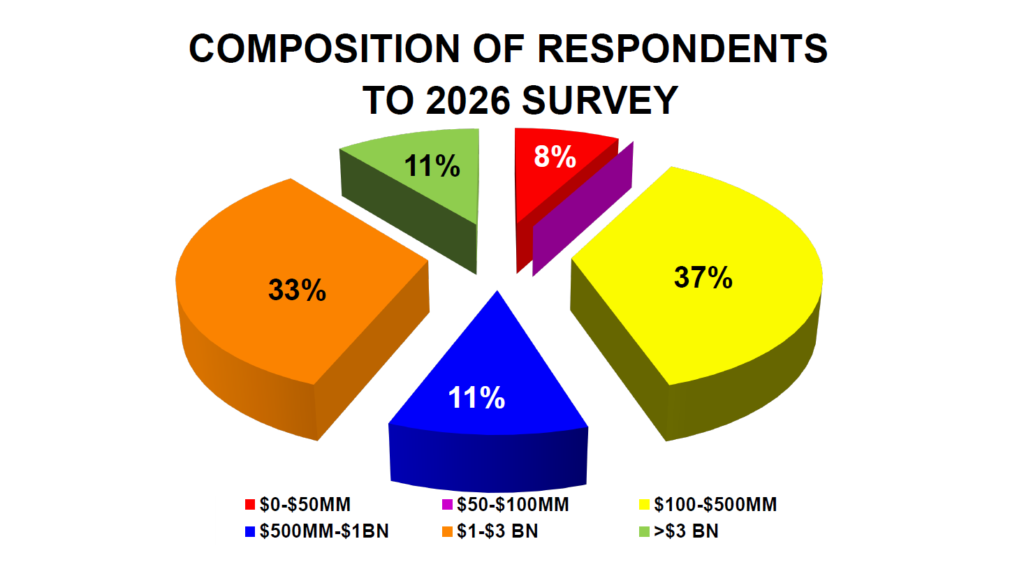
Lessors reported that they added the following amounts of equipment to their portfolios in 2025: 8% added up to $100 million; 37% added $100 to $500 million; 11% added $500 million to $1 billion; 33% added $1 to $3 billion; and 11% added over $3 billion. Thus, this survey was heavily influenced by the 44% of lessors in the “$1 billion to over $3 billion” category and the 37% of lessors who added $100 million to $500 million of equipment to their portfolios in 2025.
SURVEY RESULTS
Future Leasing and Finance Business Volume
The survey consisted of seven questions. One of the most important asked for the “Total dollar amount (volume) of business per specific equipment type expected to be booked by your firm, (in the future) 2026 compared to 2025?” Respondents were simply asked to select either the “increase,” “about the same,” or “decrease” box, with the final score, referred to as a Net Rising Index (NRI) representing the difference between the percentage of respondents increasing (+) and decreasing (−) for each type.
Chart I illustrates the ‘NRI’ results for the 15 equipment types surveyed by future opportunities. Interestingly, favorable scores were tabulated for many of the same types of equipment as last year. However, overall, this year’s volume results were stronger compared with last year’s (both increases and decreases). For example, machine tools finished first with a (+63), versus (+52) last year, (+71) in 2024, and (+47) in 2023; aircraft, in second place scored (+62), compared to (+46) last year, (+19) in 2024, up from (+6) in 2023, followed by construction tied for third place with medical at a score of (+50), compared to (+62) in 2025, (+81) in 2024 and (+66) in 2023; and medical with a score of (+50), compared to (+48) last year, (+34) in 2024 and (+65) in 2023.
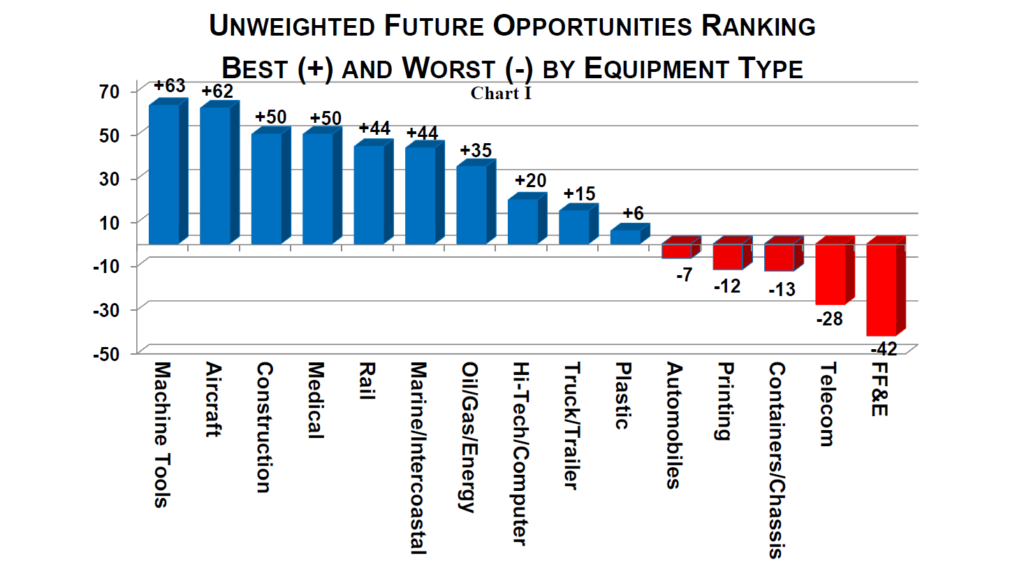
Rail, tied for fifth place with marine / intercoastal, scored (+44), versus (+6) last year; marine / intercoastal also scored at (+44) this year, compared to (+31) last year, (+20) in 2024 and (+15) in 2023; then oil / gas / energy (O/G/E) scored a (+35), compared to (+47) last year, (+19) in 2024 and (+5) in 2023; followed by hi-tech / computer with a score of (+20), compared to a (+31) last year, (+39) in 2024,and (+24) in 2023. Truck / trailer scored (+15) compared to (+17) last year, after its plunge to (-2) in 2024, compared to (+30) in 2023; finally, plastic finished tenth with a score of (+6) compared to (+17) last year, (+5) in 2024 and (+14) in 2023.
This year five types showed negative results, compared to two last year, five in 2024 and three in 2023. Automobiles finished 10th scoring a (-7), compared to (+6) in 2025 and (-5) in 2024; printing finished eleventh with a score of (-12), compared to last place last year with a score of (-26), then (-28) in 2024 and 2023; containers / chassis finished 13th with a score of (-13) compared to (-3) last year, (+5) in 2024 and (+8) in 2023; telecom scored next-to-last place with a (-28), versus (+6) last year, (-5) in 2024, and (-19) in 2023 and; finally, Furniture, Fixtures & Equipment (FF&E) finished last with a score of (-42), compared to (+8) in 2025, notably its first positive score in the previous 8 years, rising from (-7) in 2024, and (-2) in 2023.
The results of this year’s survey resemble last year’s, with many of the top “Hot” types staying “Hot” and the “Not” types. With few exceptions, high scores were stronger than last year and low scores lower; thus, it can be assumed that lease / finance volumes will increase this year.
Based on past surveys, a score of +20 or greater indicates a strong preference for adding a specific type of equipment to the portfolio during the coming year, while a score of -20 or greater indicates a strong preference for not adding.
Chart I shows a strong preference for adding eight types of equipment, up from seven last year and five in 2023 & 2024, down from nine types in 2022 and six types in 2021. This year’s survey also found a strong preference for ‘not adding’ two types (telecom and FF&E), a change from one type for the last four years. Thus, the results of this year’s survey for adding certain types of equipment (>+20) have increased from last year, indicating expansion.
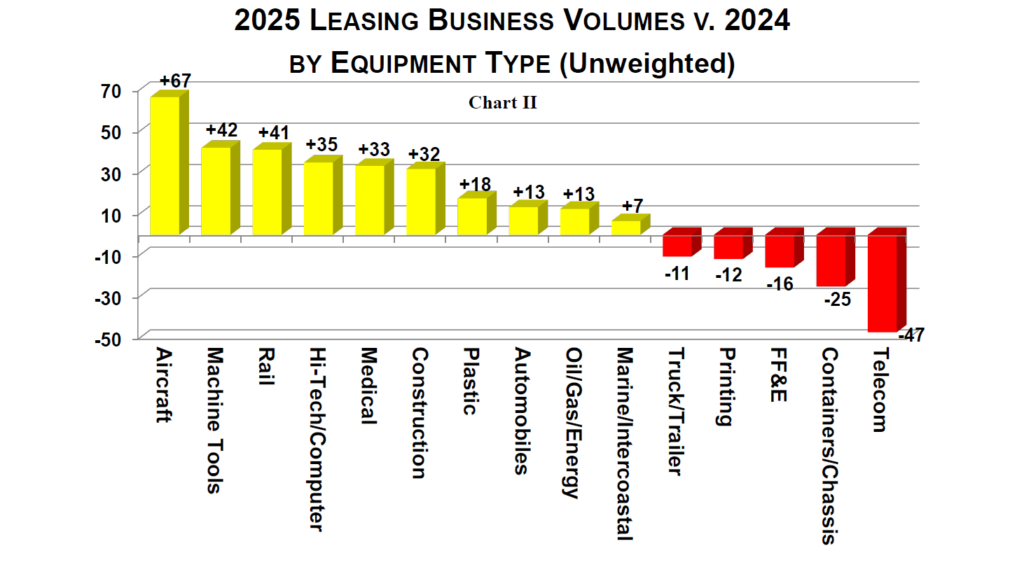
Using the same Net Rising Index (NRI) scoring methodology, Question VI (A) asked for “The total (current) amount of business (volume) that was booked by your firm per specific equipment type as of year-end 2025 versus 2024?” The responses to this question, illustrated in Chart II, indicate 2025 business volume conditions were similar but higher than 2023 and 2024. There was a strong preference (score of 20+) for six equipment types, versus five types last year, three in 2024 and five types in 2023. This year’s survey also showed a lack of preference for two types – containers / chassis (-25), versus (+12) in 2024; and telecom (-47), versus (-9) in 2024. This year’s ‘add / not add‘ survey results are stronger than last year’s, with many scores higher. This illustrates a loosening of market conditions, as many companies are successfully working through some of the effects of the pandemic, rising interest rates, tariffs, and a potential economic slowdown.
CHANGES IN RESIDUAL ASSUMPTIONS
Residuals Trending Lower
Finally, Question VI(C) asked for “change in the amount of residual value assumed this year (increase / no change / decrease) per specific equipment type in comparison to last year.” The results found on Chart III shows that this year the industry remained conservative on residual value positions for many types of equipment, and more optimistic for five types.
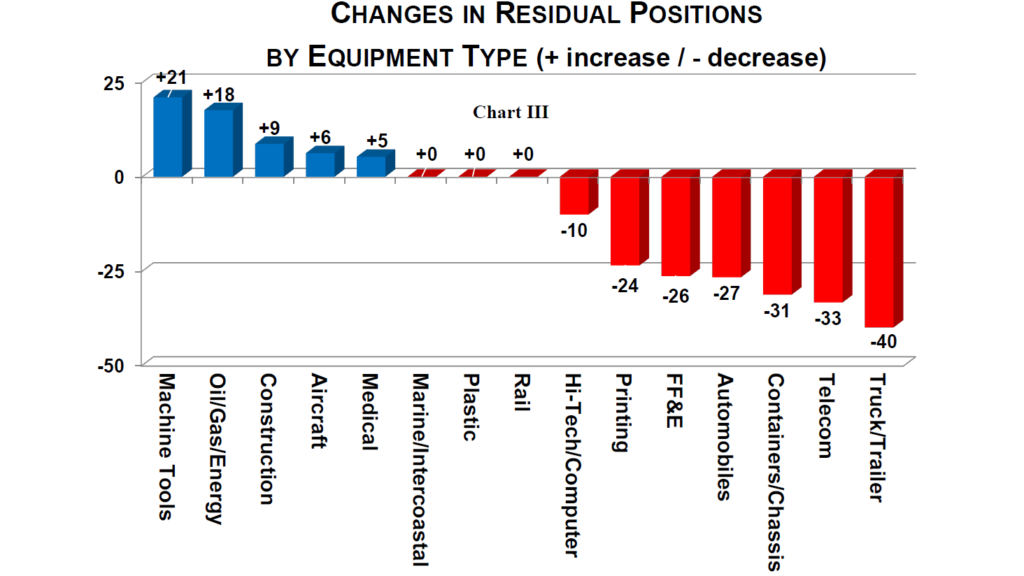
This reflects an improving outlook on the effects of interest rates, regulations, tariffs and a possible economic slowdown. This year five types showed a preference to increase residuals, the same number as last year, compared with only two types in 2024 and 2023; three types were neutral (0) and 7 of 15 types showed a preference to decrease residual positions (versus eight types in 2024, and 13 types in 2023). It should be noted that 2010 (the “Great Recession”) was the third time in the 36-year history of this survey that all equipment types scored negative. This year’s residual results were similar to last year’s (still conservative and risk averse), showing the majority of equipment types (seven of 15)having residuals lowered. This illustrates the impact of the previously noted outlook and other major concerns, not to mention equipment regulations and technology, on residual value assumptions. Overall, on a net percentage basis, 5 to 21 percentage points more respondents increased residual value assumptions than decreased them: the five types were machine tools, oil/gas/energy, construction, aircraft, and medical equipment; for three types (marine / intercoastal, plastic and rail) equal numbers increased as decreased; while for all other equipment types more respondents lowered residual NRIs than increased them, by a net (-10) to (-40), somewhat lower than last year. It is clear that the industry is becoming more accepting of some equipment types it views as more or less desirable, as seen in this year’s scores.
Historically, positive results (increases) in residual positions, taken together with positive results of 20 or more in the survey’s future business volume question, indicate a strong willingness on a lessor’s part (or if negative, a lack thereof) to aggressively seek (or avoid) business within certain equipment types. Overall, this year’s survey showed one very positive type (machine tools at (+21)), versus (0) last year & in 2023. Meanwhile one type (truck / trailer) showed ‘very negative’ results this year (-40), versus two types last year, and four types in 2023. It appears lessors have become more cautious and risk averse on many equipment types.
Most and Least Favorable Future Equipment Leasing Opportunities
Weighted Results
For clarification and correlation purposes, additional questions were asked and a ‘weighted’ approach to scoring the survey was used (i.e., Questions III and IV), versus the previously discussed ‘unweighted’ approach (i.e., Question VI). Questions III and IV asked respondents to pick only the three best and worst future equipment leasing opportunities (in order, 1 through 3) by specific equipment type.
The results for each equipment type were weighted by assigning a numerical weighting factor (multiplier) to each ‘place’ selected, whether positive or negative. For example, a first place vote was assigned five (5) points, a second place vote three (3) points and a third place vote one (1) point. A weighted score was tabulated for each equipment category by multiplying the actual number of votes for each place by their respective multipliers (+ or –), then summing the total. A final weighted equipment score (net weighted score) was determined by calculating the difference between each equipment type’s total positive and total negative weighted scores. Note, this year the weighted results for the most part, (see Chart IV), show a very close correlation with the unweighted results (see Chart I), in that the general order of equipment types (with a few exceptions) – best to worst – is similar in both approaches (weighted / unweighted). This lends support to the survey’s findings.
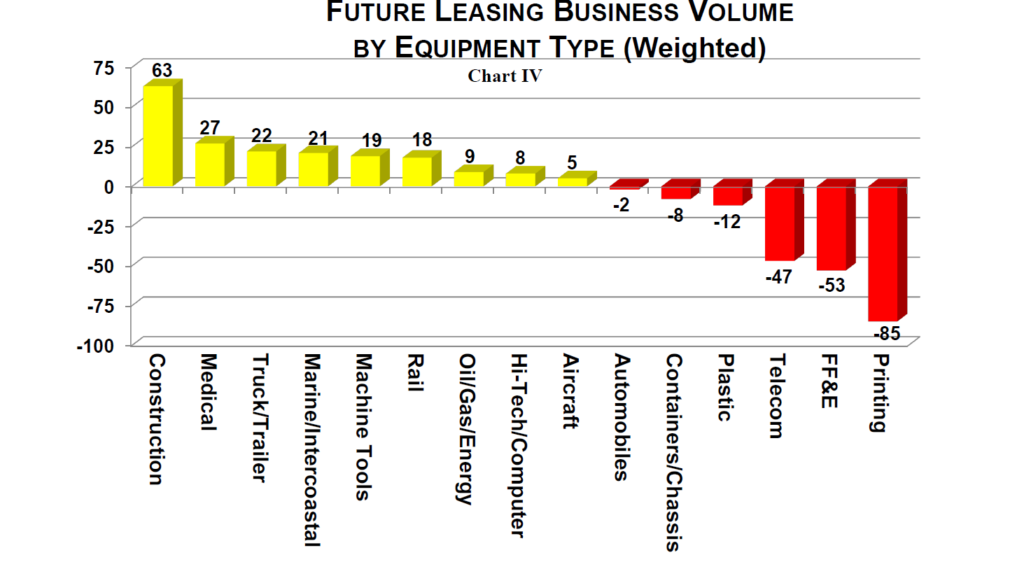
However, the overall weighted score difference between this year’s most positive and negative scores shows the most positive score (+63 vs +240) and negative score lower (-85 vs -224), indicating that the industry is more aware of what it likes and doesn’t.
The weighted scoring approach indicates the level of preference (strong or weak) for a specific type of equipment. This year’s results show that respondents expect strong future equipment leasing opportunities(>+20) for: construction (+63), versus (+240) last year, (+253) in 2024, and (+215) in 2023; medical (+27),versus (+119) last year, (+111) in 2024 and (+77) in 2023; truck / trailer at (+22), compared with (-14) last year, greatly recovered from 2024’s plunge to (-91), versus (+85) in 2023; and marine / intercostal (+21), versus (+14) last year, (+13) in 2024, and (-5) in 2023. Less strong but positive outlooks are seen for machine tools (+19), versus (+85) last year, (+107) in 2024, and (+86) in 2023; then rail at (+18) versus (-17) last year, (-11) in 2024, and (-26) in 2023. Also scoring well were oil/gas/energy (+9), versus (+45) last year, (-27) in 2024, and (-38) in 2023; hi-tech / computer (+8) versus (+30) last year, (+55) in 2024, and (+26) in 2023; and aircraft scored (+5), versus (-15) last year, (-17) in 2024, and (-15) in 2023. Meanwhile, weak outlooks were found for automobiles (-2) versus (-43) last year, (-19) in 2024, and (-32) in 2023; containers / chassis (-8), versus (-26) last year, (-28) in 2024, and (-19) in 2023; and plastic at (-12) versus (-21) last year, (-15) in 2024, and (-19) in 2023. Finally, poor outlooks (>-20) included: telecom at (-47), versus (-84) last year, (-63) in 2024, and (-48) in 2023; and FF&E (-53), versus (-65) last year, (-60) in 2024, and (-100) in 2023. Finally, printing scored the lowest (-85), versus (-224) last year, (-203) in 2024, and (-161) in 2023. It is interesting to note that 3 out of this year’s top 5 scorers were also in the top 5 last year. This year’s best and worst scores, construction (at +63) and printing (at -85, the bottom) are polar opposites, clearly illustrating exactly “what’s hot and what’s not” in the equipment leasing and finance industry. Overall, survey respondents rated four (4) equipment types very high (+20 or greater) versus five (5) last year, four (4) in 2024, and five (5) in 2023 through 2021This contrasts with three (3) equipment types rated very low, versus six (6) equipment types last year, and the same as 2024 through 2022. Thus, these scores seem to indicate that leasing and finance companies are more selective about which equipment types they think will fare best in the future.
Final Overall Ranking
Construction Equipment Repeats Again as Winner, with Truck/Trailer in Recovery Mode, While FF&E Falling to the Bottom
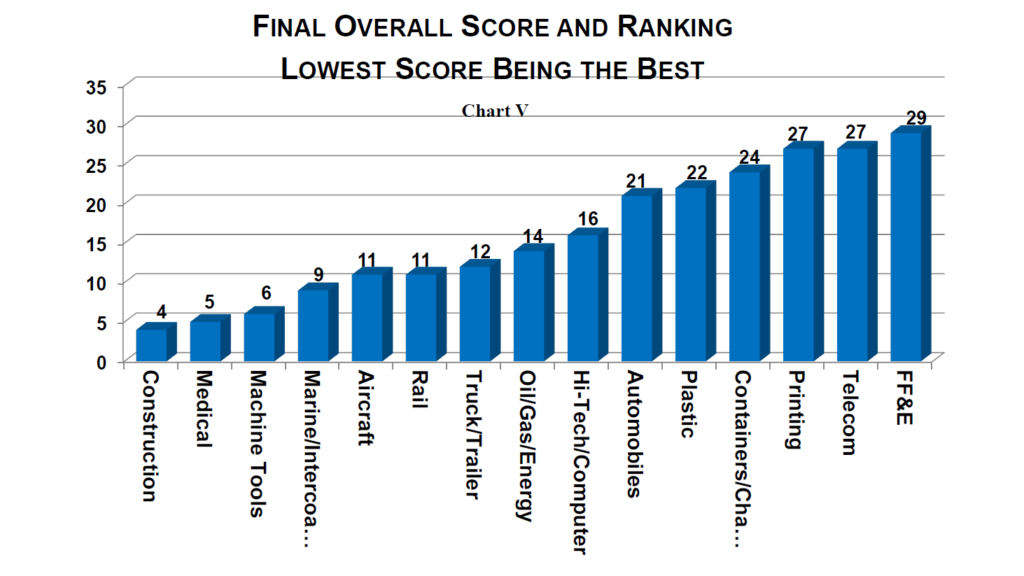
Finally, a combined overall score was tabulated by summing each equipment type’s place (rank) for survey Question VI(B) – the amount of future leasing and finance volume – unweighted, and Questions III and IV – the best and worst future equipment leasing and finance opportunities – weighted. The combined final results, shown on Chart V, indicate that this year there was no change in the most desirable top three. There is a very strong sentiment for the top-scoring types like construction, medical, machine tools, marine / intercoastal, aircraft and rail. Several types saw improvements in scores (2026 v 2025), such as rail, automobiles, truck/trailer, containers, marine / intercoastal, aircraft and printing. Other types showed a slight decline in preference, such as construction, machine tools, plastic and telecom. Even worse, hi-tech / computer, plastic, O/G/E, and FF&E had poor year-over-year showings. The lower the overall score, the better the ranking. For instance, construction, which has a combined overall score of 4, finished first overall for the twelfth year in a row. It finished third in unweighted Future Opportunities and first in Future Leasing Business Volume, while FF&E (Furniture, Fixtures & Equipment) took last place with a score of 29 (15 + 14).
Changes In Preference
Construction Narrowly Retains First, Preference Sharply Increases for Rail, While O/G/E and Hi-Tech / Computer Sag
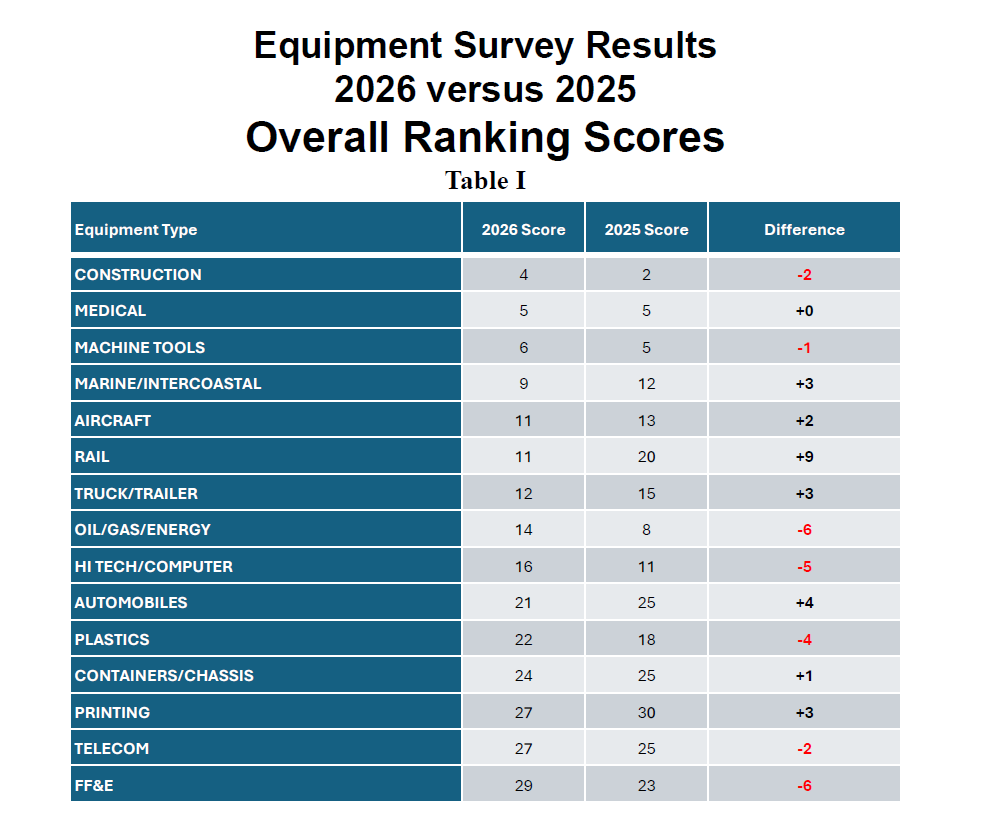
Table I shows a comparison between the overall results of the 2026 and 2025 surveys, in order to determine trends (preferences) in lease finance towards (“+”), or away from (“–”) certain types of equipment over the past year. Once again, the overall combined scores taken from the final rankings for each of the two years were compared. The lower the score the better, and the larger the year-over-year difference the greater the trend (preference) towards (“+”) or away from (“–”) a given type. The best year-over-year improvement in preference came from rail (+9), and the worst year-over-year movers were O/G/E and FF&E at (-6). Overall, for 2026, it appears that leasing and finance companies have developed a greater preference for seven types, versus five types last year, eight types in 2024, and six types in 2023; no change in preference (neutral) for one type (medical), versus four last year, and two types in 2024 and 2023; and lower preference for seven equipment types, versus six last year, five in 2024, and six in 2023. Truck/trailer continues reverting to the mean after a near collapse in 2024.
Equipment Outlook
Based on the results of the 2026 survey, equipment managers and leasing and finance companies are more optimistic with their equipment outlooks.
Specifically, for the 12th year in a row, Construction equipment was the winner of the survey, edging out, by 1 point, medical, and, by 2 points, machine tools. However, in net residual value sentiment, it rose to (+9) from (-11) last year, and (+2) in 2024; also market values have softened. According to EquipmentWatch, values have continued to cool for construction equipment over the past year, with retail values falling roughly -7.6% and auction values -18.6%. However, the leasing and finance industry seems to continue to be very comfortable with this equipment type, due to its rather ‘standard’ equipment designs, long useful lives, broad demand in domestic and global markets, and finally, its vast and ‘transparent’ secondary market. The cost of new units increased by around 3% in 2025. The outlook for construction remains good, based on pent-up demand for highway, commercial and civil projects.
Medical equipment finished in second place again, just one point behind construction and one point ahead of machine tools, with a preference rating of (0) down from (+1) last year and also finished with the fifth best residual value score (+5). The future of healthcare finance remains undetermined with changes to the on-again, off-again Affordable Care Act, and adjustment to the loss of pandemic-related subsidies. US Healthcare spending rose in 2024 by an estimated 7.2% to $5.3 trillion (after 7.5% growth in 2023 following the slower growth of 2.7% in 2021 and 4.1% in 2022, following the 2020 surge of 10.3%) and is projected to have risen 5.5% to $5.6 trillion in 2025, and 5% to $5.9 trillion in 2026. Centers for Medicare & Medicaid Services forecast an average of 5.6% annual growth in spending through 2032, outpacing expected growth in GDP. Average annual Medicare expenditure growth is projected to be 7.4% for 2023-2032, after which growth is expected to be somewhat lower (7.0%), reflecting slowing enrollment growth after the last of the baby boomers (those born between 1946 and 1964) enroll in 2029. Hospital capital spending slumped -21.5% in 2023, after double digit growth from 2020 through 2022, and appears to have increased about 3% in 2024 and increased again in 2025, with significant increases to purchase and support AI. More than half (54%) of Medicare beneficiaries are now enrolled in a Part C (Medicare Advantage), and the administration is increasing oversight of these plans, accusing them of blocking access to care through excessive preapproval requirements. The American Medical Association is pressing Medicare for physician payments linked to inflation, on the basis that when adjusted for inflation, payments would have dropped by 29% since 2001.
Leased equipment remains popular in this industry, with capital investment driven by demographics linked to the increasing health care needs of the ‘baby-boom’ generation. Robotic- and AI-assisted surgery is making strides with the release of Medtronic’s Hugo, intended competitor with Intuitive Surgical’s DaVinci. Such systems represent a substantial investment for a hospital. Return-on-investment timelines vary considerably by healthcare setting and surgical specialty, but high-volume centers have recorded positive ROI within three to five years, driven by procedural efficiency, higher throughput and better clinical outcomes translating to lower complication management costs. The medical equipment secondary market is robust, and the global refurbished medical imaging market is estimated to have been $13 billion in 2024 and is expected to grow at 15% CAGR through 2032.
Machine tools finished in third place this year, just one behind medical, with respondents reporting again by far the best net increase in assumed residual values (+21) of all types up from (+18) last year. This ranking is believed to be linked to demand from the primary metal manufacturers and allied industries (industrial machining, metal working, molds, specialty tools & dies, etc.). In 2020 orders for machine tools fell by -14.8%. It should be noted that a falloff in automobile manufacturing during that year, caused by effects of the pandemic, greatly influenced this market via lockdowns combined with chip and parts shortages. However, orders increased sharply in 2021 by around 50% year over year, but, in 2022, fell -5.0% lower than 2021’s record year, fell again in 2023 by -10.7%, then decreased by -3.7% in 2024. However, they increased by about +22.5% in 2025 and are forecast to increase again in 2026. Total orders still remain elevated. In the secondary market, CNC machining centers, turning centers and lathes are in demand. Transportation, food processing, general equipment and agricultural industries are expected to account for more than half of consumption. The secondary market for machine tools has been buoyed by replacement and some new demand for higher tech equipment, used pricing is expected to remain elevated, as machine tools manufactured since 2014 are now entering the market.
Marine / Intercoastal, this year finished in fourth place, up from sixth place last year, fifth in 2024, sixth place in 2023, eighth place in 2022 and 11th in 2021, showing a moderate increase in preference (+3) from (-2) last year, and no change in net residual value sentiment (+0) from (+6) last year, (-3) in 2024 and (-9) in 2023. The market continues to improve. Blue water vessels performed well, and secondhand prices were at sound levels for most vessels. Box ships were trending down, then bounced back for an increase of +6%. Starting new year 2025, values for 5-year-old bulkers changed about +7% and for tankers +3% for the year depending on the size. Meanwhile, conditions improved in the intercoastal segment, as supply and demand have come into balance. New buildings have slowed, causing values to increase. In 2021, new prices for OT hopper barges increased by around +65% to 80% from pre-pandemic levels, then fell by 10% over the next 2 years, finally increasing by 10% in 2024-2025 with high demand and limited availability. Tank barges performed well, with utilization rates in the low to mid 90s. Even offshore and platform supply vessel (OSV and PSV) markets continued to improve, but flattened out by year end, with some vessels selling for ‘asking’, not ‘best offer’ or scrap. These vessels had seen prices decline by 50% to 70% or more compared to seven years ago. Some lease (charter) rates declined by over 90%, but the market is now improving in step with the oil market. The inland river push boat secondary market remains at high levels. Meanwhile, ship docking tugs and coastal / ocean going tugs are in good demand.
Aircraft finished in fifth place, tied with rail, improving from seventh last year. It also showed an increase in preference (+2), the same as last year. However, net residual value assumptions improved greatly to fourth place (+6) from sixth place (+0) last year from third worst finish in 2024 at (-19). Respondents appear to view parts of the aircraft market as in continued recovery, both in the private and commercial aircraft markets. IATA estimates the global commercial sector booked losses of $138 billion for 2020, then gradually improved until finally returning to profitability in 2023 at $35.2 billion. This trend is forecast to stabilize through 2025 with earnings of $39.5 billion, and $41.0 billion in 2026. Airlines are expected to generate 3.9% margin. Revenue passenger kilometers (RPK) increased by 36.8% in 2023 and increased by an estimated 11.2% in 2024, at last achieving 100%+ of levels last seen in 2019. Commercial deliveries in 2025 show Boeing with 600 (1,162 orders), and Airbus with 793 (1,000 orders). In addition, airline MRO is projected to increase by 40% in 2026, compared to 2019, while airline capacity is just 10% higher. Cargo demand weakened in 2023, surged in 2024 due to booming e-commerce and limited capacity in ocean shipping, and remained strong in 2025 (71.6 million tons), with a 2.4% gain expected in 2026. The preowned business jet inventory (for sale) roughly doubled in 2023 from the record lows seen in 2022, marking a return to more normal market conditions compared to the post-COVID imbalances that led to jaw-dropping average price increases in the range of 50-80%. Inventories were up about 8% in 2024 giving way to a continued easing of average prices for all categories. Turboprop inventories continued to recover with values trending down. The helicopter market also continued to recover along with increased demand in the offshore sector, in particular Suriname, Brazil and Guyana. The global helicopter inventory value remained stable.
Rail finished in a tie for fifth place with aircraft, after tenth place last year, down from 6th in 2020 was a very difficult year, as year-over-year carloads shipped plunged sharply by -13%. In addition, after hitting all-time highs in 2018, intermodal traffic dove by -5.1% year over year in 2019, then by -2.0% in 2020, but rose +4.9% in 2021.By year end 2021 total carloads for all car types, including intermodal, increased by (+5.7%). However, for 2022 total carloads declined by a minute -0.3%, intermodal fell by -4.9% and total traffic by -2.8%. Then in 2023 total carloads increased by +0.7%, intermodal fell sharply by -4.9%, and total traffic fell by -2.3%. In 2024 total carloads declined by -3.0%, intermodal increased sharply by +9.3%, and total traffic increased by +3.4%. Finally, in 2025, total carloads increased by +1.5%, and intermodal units increased by +1.6%; total traffic by +1.5%. Railcar supply and demand is still a problem, for tank cars and covered hopper cars (CHCs), where the industry is accelerating its shift from 4750CF CHCs to greater than 5150CF capacity; CHCs make up a large portion of stored cars. New design standards and regulations have materially adversely affected the flammable and hazardous material tank car fleet (DOT111A, CPC 1232), leading to many scrappings. Just under twenty percent (20%) of the entire U.S. railcar fleet is currently in “storage”. Scrapping has come into vogue, as advertised scrap offers usually between $250 and $300 per gross ton; salvage value is more. After a good year in 2024 and 2025, lease rates and values of many car types increased or are holding at high levels. New railcar deliveries plunged by over 42.5% in 2020 and fell again by just over 12% in 2021. In 2022 new car deliveries increased by near 40%, in 2023 increased again by 10.5%, and in 2024 by 2.2%. For 2025, new car deliveries fell by -5.8%. The overall outlook is expected to continue to improve as more supply chain problems are ironed out and trade increases.
Truck / trailer improved again this year, finishing seventh up from eighth place last year, recovering from 2024’s near collapse when it tied for twelfth place (-25). This year it logged a gain (+3) in net preference after a (+10) last year and a huge loss in net preference with a score of (-18) in 2024, the second largest drop in the 36-year history of this survey. It also finished in last place on changes in residual position (lower), scoring a (-40), after (-38) in 2025. Overall, truck / trailer is on a path to recovery. New class 8 truck sales fell by about -12.5% in 2025, after falling -10% in 2024, increasing by around +5% in 2023, +14.6% in 2022 and by +16% in 2021. Sale volumes of used class 8 trucks rose by +7.0% in 2023, then +11.4% in 2024, and +17% in 2025. Average retail used sleeper prices fell -30.7% in 2023, then -12.9% in 2024 and increased +0.5% in 2025. The average used heavy truck retail sales price climbed to $57,048 in December. Meanwhile, orders for new trailers increased by 48% in 2020, then fell by 17% in 2021, due to ”supply chain and staffing issues”, before increasing by 45% in 2022, then plunging by -33% in 2023, and -31% in 2024, then increasing by 6.2% in 2025. To make matters even more interesting, electric heavy trucks are continuing to enter the market at low levels and high prices with a lack of infrastructure and relatively low mileage ranges. Meanwhile, year-end dry van truckload spot rates increased +3.8% and contract rates increased +1.0% YOY. Spot rates increased 3.1% in December to $2.41. Overall for 2025, spot rates were $2.27 for dry vans and $2.64 for reefers. This is following a robust 2021 where spot rates increased +28%, then subsequently pulled back 6% in 2022, and -19% in 2023. At the same time contract rates increased by +13% in 2021 and +7% in 2022, then pulled back -7% in 2023. FTR expects future contract rates to increase by 2% to 5%, ending the freight recession. In addition, business failures are continuing to increase at around 10 large failures per month. Finally, the EPA’s “GHG Emissions Standards Phase 3 will greatly impact model year trucks 2027-2032.” This regulation is said to have “unprecedented negative impacts on commercial trucking.” According to ACT Research, “If the EPA’s Clean Truck regulation does [sic] down, the prebuy thesis goes too, returning demand to market-derived levels. With a young fleet, fully stocked inventories, low carrier profits, low equipment valuations and high interest rates, a roll back would rewrite 2026-2027 expectations.” The regulations have been revised, taking out the extended warranty. The outlook still remains challenging.
Oil/gas/energy fell to eighth place from fourth place last year. Just 11 years ago O/G/E was in second place. Then in the 2016 survey, O/G/E’s negative score of (-408) smashed the ‘weighted results’ all-time record low set by Printing (-279) in 2013. Its outlook has improved greatly considering the change in administration’s, ‘drill, baby, drill’. There are still new regulations set by the Administration, EPA, and CARB that could negatively impact this sector. It also finished strongly in 2nd place in net residual value assumptions (+18). This finish is rising to the top of other types, an improvement once again over last year. With oil drilling increasing from very low levels in 2020 and a new administration in 2025, there is cause for optimism. This situation also positively affected values of oil/gas production and exploration equipment, as well as operating cash flows. The Baker Hughes rotary rig count at year end 2025 showed a US YOY decrease of -5.6%, after a decline of -5.9% in 2024. Overall, it’s about 11% higher than 2020. Also of note, today more gas and oil can be produced with fewer drilling rigs thanks to technology advances. Meanwhile. used prices in the oil patch had fallen by 20% to 50% but are now recovering. According to the EIA, WTI prices in 2021 averaged $68/Bbl, rising sharply in 2022 to $95, falling in 2023 to $78, again in 2024 to $77/Bbl, and finally $69/Bbl in 2025. WTI is forecast to fall to $52/Bbl in 2026. Meanwhile, U.S. natural gas electric utility generation was 39% of total energy in 2020, fell to 36% in 2021, increased to 39% in 2022, rose to 42% in 2023 and to 43% in 2024. The average price of Henry Hub natural gas was $2.11 / MMBtu in 2020, increased to $4.13 in 2021 and then rose sharply to $6.40 in 2022, fell to $2.50 in 2023, rose to $3.94 year end 2024, and $3.57 in 2025. For 2026 it is forecast to be at average price of $3.50.
Renewables used to generate electricity (non-hydro) climbed from 14% in 2021 to 21% in 2022, 22% in 2023 and 23% in 2024. Coal’s share rose from 20% in 2020 to 22% in 2021, then fell to 20% in 2022, to 17% in 2023, and to 15% in 2024. Finally, nuclear’s share averaged 21% in 2020, then 20% in 2021, 19% in 2022 through 2024. Note: in March of 2025 fossil fuels dropped below 50% of the total U.S. electric generation mix. The Trump administration is expected to support oil and gas drilling and soften regulations related to the energy industry.
Hi-tech / computers finished in ninth place, versus fifth last year, with an increase in the percentage of respondents lowering residual value assumptions from (+6) in 2025 to (-10) in 2026. This industry continues to operate on very low margins but has a vast secondary market. Thus, volume is important. In 2025, global new computer sales rose +2.7%, after +8.7% in 2024, expected to be followed by a -8% drop in 2026. This followed 2022’s record decline of -16.5%, as most system refreshes were completed. After 14 consecutive quarters of declining unit sales starting in 2011, global PC shipments grew 2018 through 2021. Top vendors in 2025 were Lenovo (27.2%, with 17.6% growth), followed by HP (21.3%) and Dell (15.3%). New PC prices are increasing, a trend expected to continue in 2026 due to memory shortages. Spurred by AI, global server shipments grew +2.1% in 2024 and expected to grow +7.8% in 2025, and +12.8% in 2026. Chip technology advanced to volume production at smaller nodes in 2025: TSMC to 2-nm and Intel to 1.8-nm. Global revenues from semiconductors and semiconductor equipment grew +26% and +13.7%, respectively, in 2025, with respective +23% and +9% growth forecast for 2026. Used prices for newer PCs are expected to increase, mirroring the new price increases. Secondhand laptops continue to bring better prices than desktops and sell quicker.
Automobiles finished in tenth place, improving from a three-way tie for twelfth place last year, and from eleventh in 2024. It also finished in 12th place for changes in residual value position (-27), versus 13th place (-31) last year. Wholesale prices moved up and down throughout 2025 but finished the year +0.4% year over year. According to J.D. Power, ‘wholesale’ price changes for used light vehicles declined an average of -7% in 2024, a far cry from 2021 when prices increased +47%. Average new car price was $50,080 (compared to $38,000 in 2020). Today 17% of auto loans have “steep payments” of $1,000/month and higher – a developing affordability crisis. In 2015 only around 2% of loans were steep. Auto dealers are now pushing 84-mo financings. Total new U.S. light vehicle unit sales increased by 12.5% to about 15.6 million in 2023. New sales then increased to 16.03 million in 2024 (+2.6%), and to 16.3 million (+1.7%) in 2025. Meanwhile, leasing penetration increased from 21% in 2023, to 26% in 2024, and 24% in 2025. In addition, for EVs, complications of the low desirability related to initial cost, charging issues, range and repair costs; the “EV Winter” all impact value. The EV share of one-to-five-year old used cars was 3.3% in 2025, up from 2.9% in 2024. In 2025 average used EV prices fell -4.8%, compared to a year earlier, while gasoline vehicle prices rose +5.2%. Used EVs sell for about $1,200 less than gas vehicles. Average price of used EVs 6/24 — $32,923 vs average June ’25 — $31,354 (-4.8% YOY). Average price of used gasoline 8/24 — $30,931 vs average June ’25 — $32,525 (+5.2% YOY).
Plastic equipment finished in eleventh place, down from ninth place last year, eighth place the year before, with a moderate decline (-4) in preference, and no change (+0) in respondents’ residual value assumptions. Currently, this market segment is expected to improve in 2026, after an OK 2025, following a few tough years in 2023 & ‘24. Sales of new injection molding machines fell about 15% in 2019, this after a nine-year expansion (2009-2018), then rising 3.3% in 2020 to 4,082 units. Sales were very strong in 2021, showing a YOY increase of 22.5% to around 5,000 units, then fell in 2022 by 15%, due to a very slow second half of the year. In 2023, new sales plunged by 28.5% then fell by 3.3% in 2024, and increased by 1.3% in 2025, as companies right sized. Meanwhile twin-screw extruders had shipment increases of over 40% in 2025. In addition, shipments for single screw extruders increased by around 10% for the year. Used prices for plastic injection molding machines have generally held up well over the past several years. Much of this is thanks to the automotive industry, which requires high-capacity IMMs for its products, and auto parts suppliers which utilize small to medium capacity plastic equipment. Used single-and twin-screw extruders also did well. Also, new and used blow molding equipment prices related to PET bottling held up better than last year due to advances in technology and industry consolidation.
Containers / chassis finished in twelfth place, the same as last year and two places lower than the year before, with a slight rise in preference (+1), and thirteenth place in net residual value position (-31), versus (-16) last year. Due to effects of the pandemic, primary market sales for ISO containers in 2020 could not keep up with demand. This very heavy demand for containers continued in 2021, with the average new prices during the year increasing by 45% to 130%. Shipping charges for west to east increased by 6X pre-pandemic. However, in 2022, new sales volume fell by 40%, and new prices by 30%, as supply and demand started to come into balance. In 2023, global new container sales volume continued to fall by -40%, along with prices by (-25%). However, with vessels being routed via the Cape of Good Hope on most Asia/Europe and several Asia/U.S. East Coast services, significantly more containers were needed to satisfy trade. Thus, for 2024, global container sales volume increased sharply by 300+%. However, in 2024 average new prices fell by -8%, and used prices by -3%. Total DV containers built in 2025 could finish at twice the initial forecast and approach 5.0 million TEU. That said, large production cuts are expected in 2026 . Meanwhile, reefer production increased to record levels of 345,000 TEU in 2025 but is forecast to fall to 230,000-270,000 TEU per year for the near term, with 2026 forecast to produce 258,000 TEU. It should be interesting to see the effects of new tariffs on trade this year.
After finishing in last place for fifteen years out of the past sixteen, Printing equipment tied for second to last place with telecom. This equipment type continues to register a very poor showing in this survey. These results seem to sum up the leasing and finance industry’s continued very negative outlook for printing equipment. In addition, printing finished in tenth place (-24) in net residual value change assumptions after finishing tied with trucking for last place last year (-38). The economics surrounding this industry remain challenging, as more and more publications, flyers, newspapers, etc. move away from print media to digital. Additionally, print ad spending was estimated to have fallen by -12.5% in 2024, and by -14.4% in 2025. Meanwhile, digital press sales continued to increase at the expense of traditional press room equipment. Inkjet remains the dominant technology. Although this equipment segment appears very weak, there is some promise in the specialty offset market, especially for plastic and packaging printers. Also, some OEMs are “selling” their equipment based on a flat annual fee plus a fee per impression. Because of increased printing bankruptcies, used equipment inventories have been rising, causing supply and demand to be out of balance. That said, some equipment is holding its own; the right brand name, type and size are critical to value.
Telecom finished second to last, tied for 13th place with printing, the same place as the past three years, with a slight decrease in preference of (-2), and net residual value sentiment declined precipitously to a second worst (-33), after falling by (-13) last year and (-16) in 2024. In this equipment segment capex spending took off in the second half of 2019 in preparation for the 5G ramp. During 2020, despite the pandemic, the equipment market grew by about 7%. Global telecom capex, after two consecutive years of reductions, stabilized in 2025 with a 1% YOY growth to an estimated $300 billion. It is expected to remain steady in 2026, as operators continue to slowly lure customers to 5G-led FWA (Fiber and Fixed Wireless Access) from cable (primarily in the US and India). Currently, the leading telecom networking equipment companies are Cisco, Ericsson, Nokia, Huawei, Samsung, ZTE, Juniper and NEC. Meanwhile, as 5G continues to roll out, the hype has become a yawn, and 3G service has officially ended. Note: Initial 6G standardization is underway for an early 2030s rollout. One stated goal is, “6G must not inherently trigger a hardware refresh of 5G RAN (Radio Access Network) infrastructure.” Studies suggest 6G will need roughly 2–3× more mid-band spectrum than today’s mobile networks to support massive data and AI functions. Consequently, in the US, federal directives are pushing agencies to vacate key spectrum bands (e.g., 7.125 – 7.4 GHz) to free them for future 6G use. Sales in the secondary market are steady and expected to remain so in the immediate future. The outlook remains stable for 2026.
FF&E finished in last place (15th), with a score of (29), falling from last year’s eleventh place score of (23), which was an improvement from 2024’s 14th place finish (26). This segment also had a large decline in preference (-6) from last year’s (+3) and 2024’s (+1). Also, net residual value assumptions declined heavily (-26), after falling by (-6) last year, and (-16) in 2024. The secondary market continues to be flush with inventory affecting wholesale prices. Business failures in 2020 added to the problem; they are presently increasing again. In 2020 sales in the primary market fell sharply by -12%, but increased in 2021 by +3.6%, again in 2022 by +3.0%, +5.1% in 2023, +4.8% in 2024 and +3.7% in 2025. Meanwhile, not surprisingly, the copier segment is challenging and is expected to remain so. In response to almost flat new copier sales, OEMs first fought for market share and control of the secondary market but have now progressed to reductions and restructuring. That said, there is some cause for concern in the FF&E segment given that 2026 job creation is expected to slow for at least the next year (unemployment rate increasing from 4.3% 2025 to 4.5-4.6% in 2026). The participation rate has also fallen, meaning fewer employees in the overall potential workforce.
Summation
Construction equipment was the overall winner for the 12th year in a row. Meanwhile FF&E finished in last place replacing “perennial” printing. In addition, medical finished second and machine tools finished third, while marine / intercoastal finished fourth, followed by aircraft in fifth place tied with rail. It’s interesting to note that four of the top six finishers repeated in this year’s survey. This shows the lease finance industry is getting comfortable with certain types of equipment.
Based on the overall results of the 2026 survey, it appears leasing and finance companies have become generally more optimistic, and more comfortable with certain types of equipment. Overall, leasing and finance companies have become more optimistic to some extent on almost all types of equipment (negative changes in residual positions: 7 in the 2026 survey, versus 8 in 2025, and 12 in 2024), a reflection of the expected effects of lowering interest rates, curbing and cutting regulations and a growing economy.
Final Comments
For reasons previously stated, this year and last mark a break from the previous two years of sagging results; this after 12 years in a row of positive survey results. This year’s survey results are positive and point to growth in the asset leasing and finance sector. The survey also shows that some lessors are lowering residuals for certain asset types, especially for containers/chassis, telecom, and truck / trailer. Some equipment markets have fallen in popularity to the point where knowledgeable operating lessors and finance companies with solid market experience can take a contrarian view to parts of this survey and consider a drop in popularity for a given equipment type to be an opportunity for future business success. Can this be viewed as an opportunity or a problem?
Perhaps the industry’s perception can best be summed up as some of the greatest threats to the secondary market:
- Economic slowdown; stubborn inflation; and interest rates;
- Inflation and tariffs;
- Geopolitical uncertainty / turmoil.
It is hoped the information contained in this article will help you chart your course to success in 2026!
Carl C. Chrappa, M.R.I.C.S., A.S.A., I.F.A. is senior managing director – asset management practice leader at the Alta Group, LLC. Carl C. Chrappa is Senior Managing Director – Asset Management Practice Leader of The Alta Group, LLC, headquartered in Clearwater, Florida. He is a registered auctioneer, recognized expert witness, and nationally (A.S.A.) as well as internationally (M.R.I.C.S.) tested and accredited senior equipment appraiser with over 50 years of experience.
Gregory S. Chrappa, A.S.A. is managing director – asset management practice at The Alta Group LLC. Mr. Chrappa has been inspecting and appraising machinery and equipment for 26+ years. He also provides research, direction, and quality control on comprehensive asset management engagements such as litigation support, remarketing, appraisal review and industry white papers.
Susan R. Chrappa, C.V.A. is director, head of operations – asset management practice at the Alta Group LLC. Ms. Savon has been inspecting and appraising machinery and equipment for 25 years. She also provides research, direction, and analysis on comprehensive asset management engagements such as business valuations, litigation support, remarketing, appraisal review and industry white papers.